
Information
What Is a Junction Box? Types, Uses and Installation Best Practices
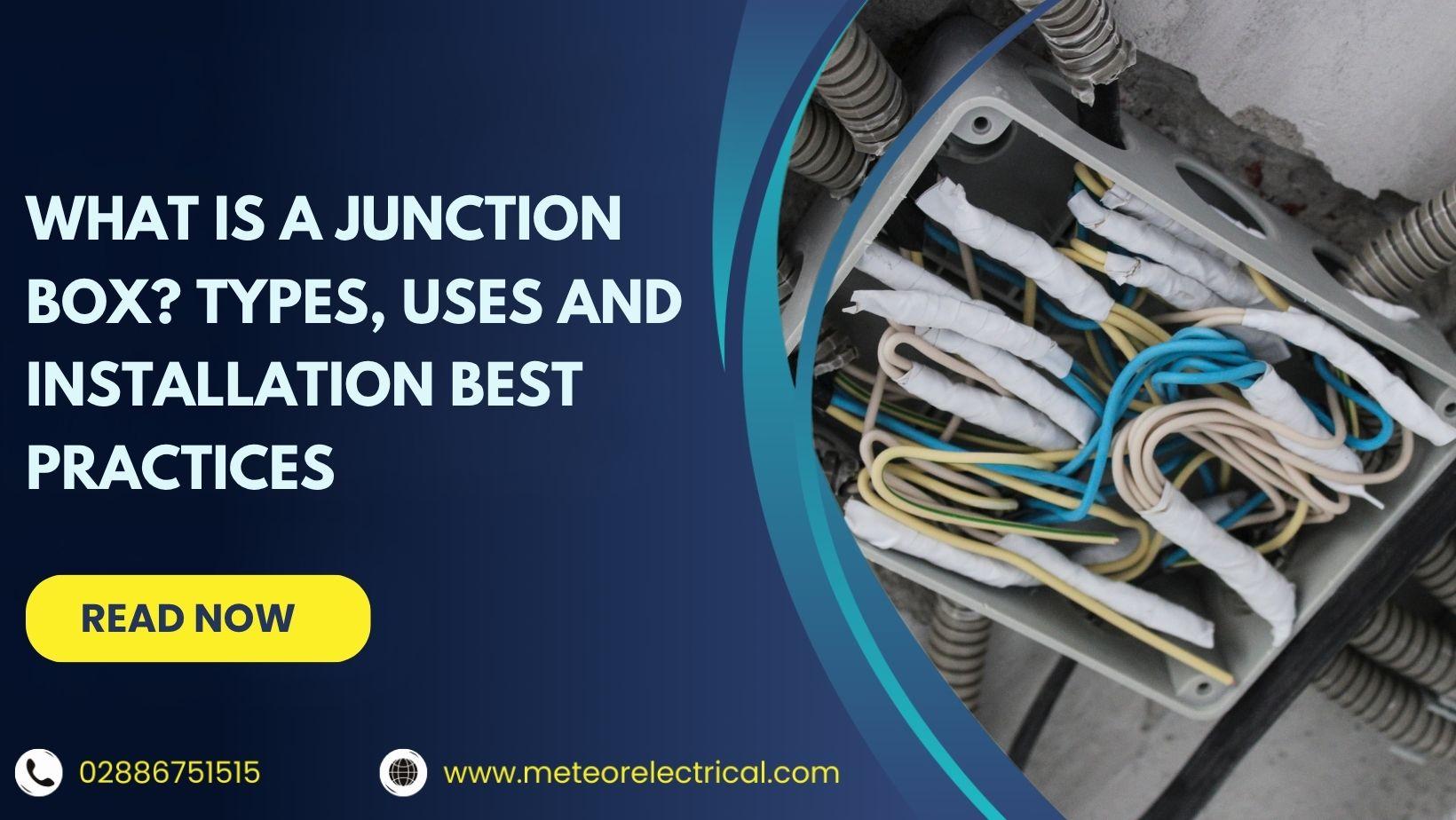
Updated October 2026 · Meteor Electrical guides · 9 min read
Quick answer: A junction box is an enclosure that safely houses electrical connections where cables are joined or branched. It protects the terminals, holds the cables in place and contains heat or sparks if a joint fails. In the UK, BS 7671 says every joint must be accessible, unless it is a maintenance-free (MF) box or connector to BS 5733.
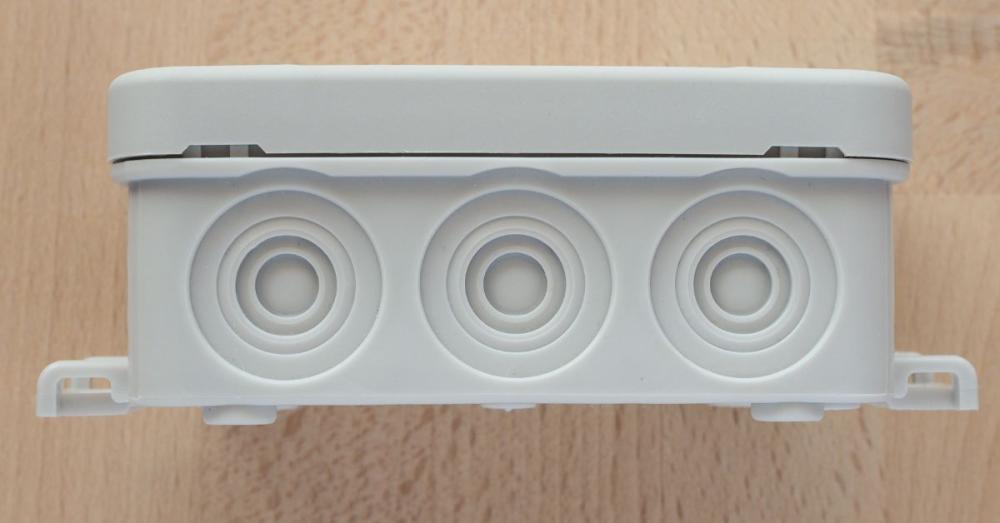
If you are extending a lighting circuit, adding a spur or wiring an outdoor light, you will almost certainly need a junction box. This guide explains what a junction box is, the main types, when maintenance-free boxes are needed, how to choose the right rating and IP rating, and the steps for a safe installation. Shop our full range of junction boxes.
In this guide
What is a junction box?
A junction box, sometimes called a joint box or J-box, is a small enclosure where two or more cables are connected together. Inside, the cores are joined on terminals or connectors, and the box’s lid and body keep those live parts away from fingers, building materials and dust.
BS 7671 requires every joint and termination in a live conductor to be made inside an enclosure, such as a junction box, an accessory box or the enclosure of the equipment itself. A twisted joint wrapped in tape inside a wall or ceiling void does not meet that requirement and is a real fire risk.
A good junction box does three jobs:
- Protects the connection from mechanical damage and accidental contact.
- Holds the cables firmly, so the conductors are not pulled out of the terminals. The outer sheath should continue into the box.
- Contains a failure: if a loose terminal overheats, the enclosure limits the spread of heat and sparks.
What types of junction box are there?
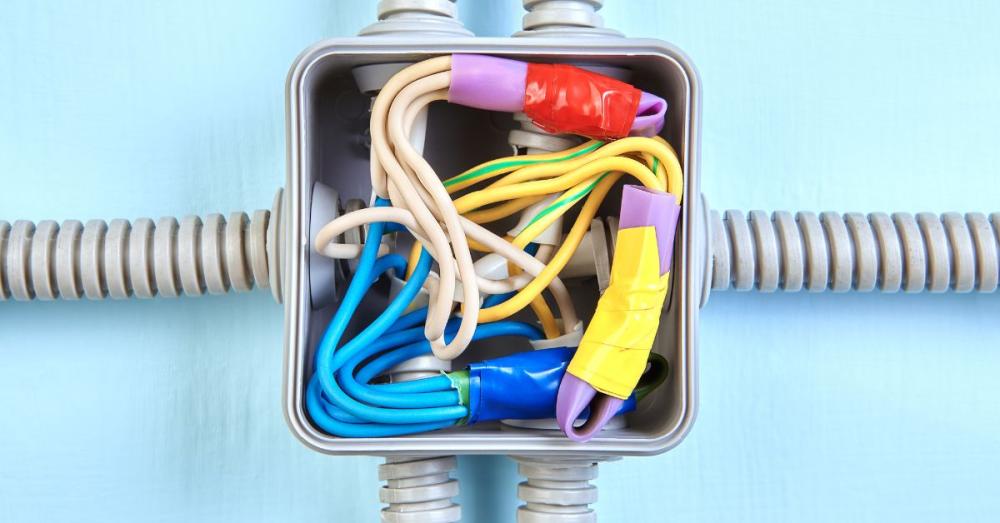
Junction boxes differ in how the conductors are connected, how many terminals they have, what they are rated for and where they can go.
| Type | How it works | Typical use |
|---|---|---|
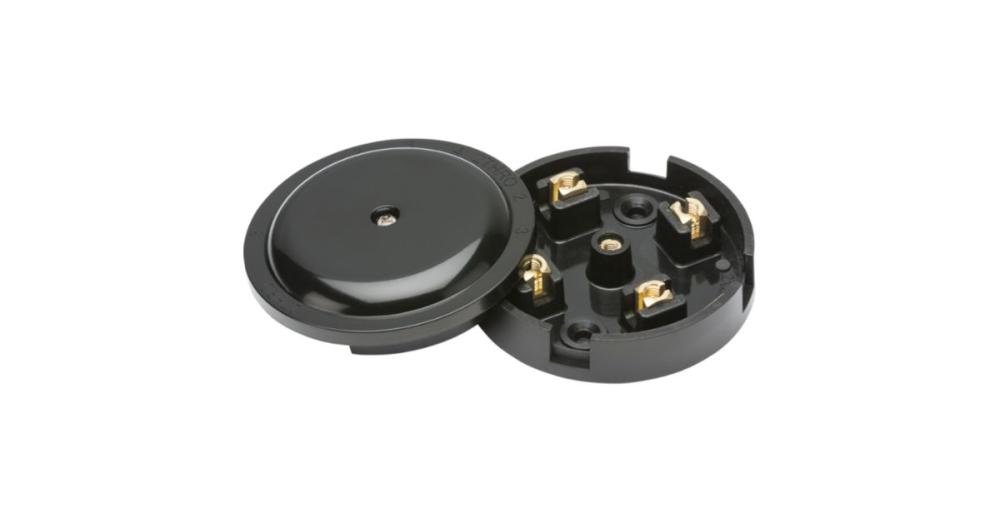
| Screw-terminal junction box | Conductors are clamped under screws on a fixed terminal block, often 3 or 4 terminals | General lighting and socket joints that stay accessible |
| Maintenance-free (MF) box | Push-in or spring connections designed never to need re-tightening; marked MF to BS 5733 | Joints that will be hidden in walls, floors or ceilings |
| Lighting connection box | Small box with a connector and cord grips for a light fitting’s flex | Downlights, LED drivers and pendant fittings |
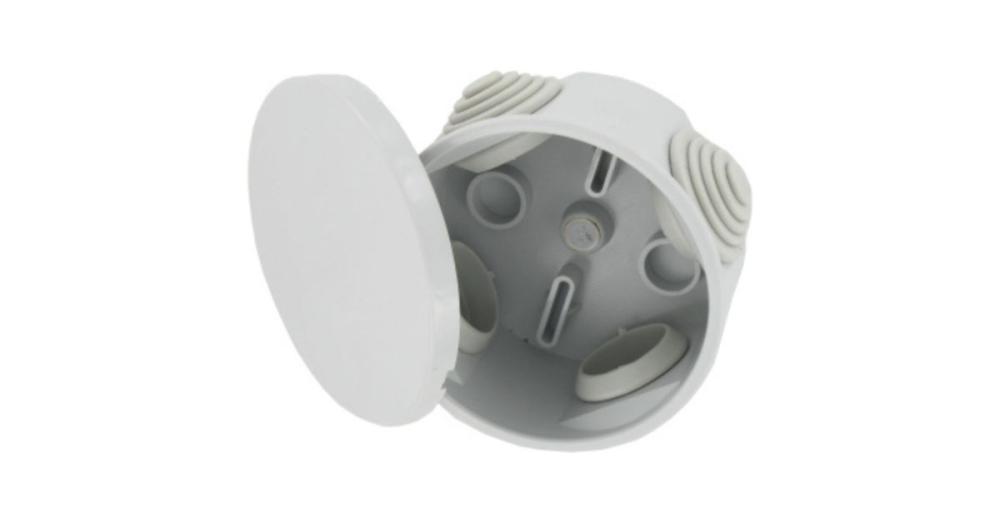
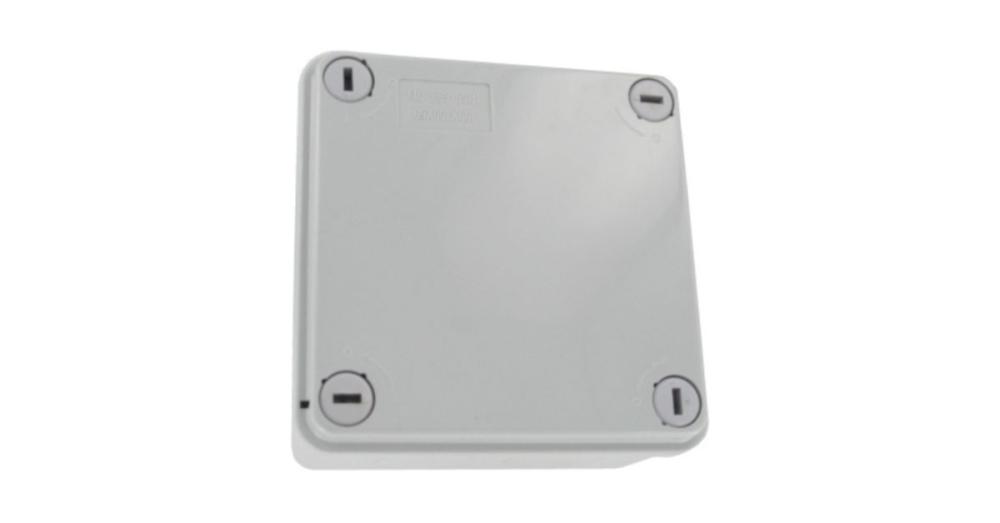
| Weatherproof (IP-rated) enclosure | Sealed box with seals, glands or grommets; IP44 up to IP66 | Outdoor lights, garden power, damp areas |
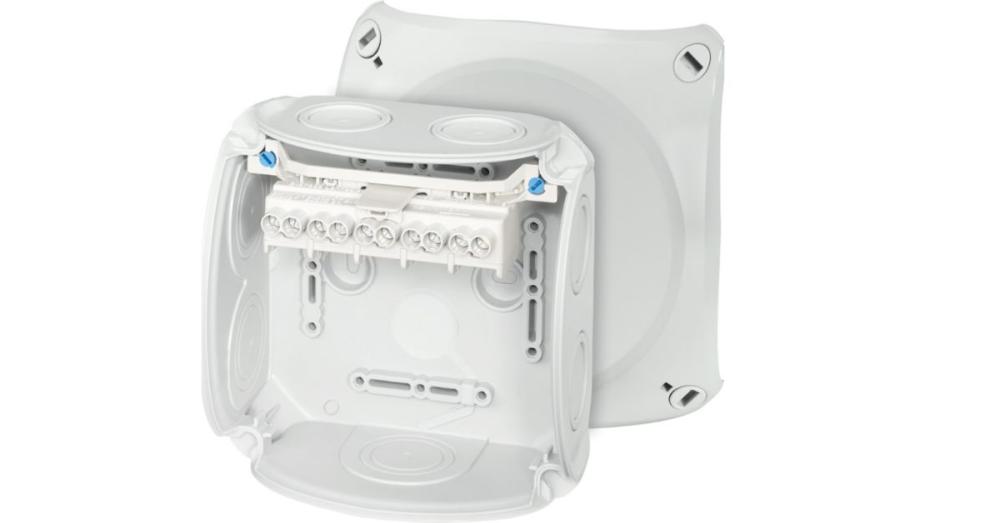
| Enclosure with connectors | Empty box fitted with lever connectors or connector strip | Larger joints, more cables or bigger conductors |
Screw-terminal junction boxes
The traditional round junction box has a fixed block of 3 or 4 brass screw terminals and knock-out entries around the edge. The Knightsbridge 20A 4-terminal junction box is a typical lighting box, and the Selectric 30A junction box with three 4mm terminals suits socket circuits. Screw terminals can loosen over time with heating and cooling, which is why these boxes must stay accessible.
Maintenance-free (MF) junction boxes
Maintenance-free junction boxes use push-in or spring connectors designed not to loosen, so they never need re-tightening. They must comply with BS 5733 and be marked with the MF symbol. Only these, and a few other permanent joint types, can be hidden where they cannot be reached later.
Lever and push-in connectors
Lever connectors (often called Wago-style connectors after one well-known maker) and push-in connectors make quick, secure joints without screws. They are widely used inside junction boxes, back boxes and light fittings. See our pushwire and lever connectors, such as Unicrimp 3-pole lever connectors and Deligo 3-conductor push-in connectors. Remember they still need an enclosure: a connector on its own is not a junction box, and it is not maintenance-free unless the whole box is marked MF.
Enclosures with connector strip
For larger joints or bigger cables, an empty enclosure fitted with connectors is often the neatest answer. Our strip and porcelain connectors include ratings from 5A to 60A, and our PVC enclosures come in a range of sizes. For box sizes and depths, see our guide to electrical box sizes.
Junction box configurations
Boxes are often described by their number of terminals or ways. A 3-terminal box joins live, neutral and earth on a simple spur or extension. A 4-terminal box adds a switched live terminal for lighting. Larger 5-way boxes and enclosures give more room for multi-branch joints. Choose a box with enough terminals and space so the cables are not crushed.
Do junction boxes need to be accessible?
Yes, in most cases. BS 7671 requires every connection to be accessible for inspection, testing and maintenance. Accessible does not have to mean visible: a box under a floorboard that can be lifted, or in a loft you can reach, is usually acceptable. A box plastered into a wall or sealed above a plasterboard ceiling is not, unless it is one of the exceptions.
The main exceptions are:
- Maintenance-free accessories marked MF and complying with BS 5733, including MF junction boxes.
- Crimped, soldered, welded or brazed joints made with the correct tools, such as crimped butt connectors.
- Compound-filled or encapsulated joints, such as resin cable joints.
- Joints designed to be buried in the ground, and joints that form part of equipment made to its own product standard.
Pro tip: If you are not sure a box will stay reachable, for example under new flooring or above a sealed ceiling, use an MF junction box from the start. It avoids having to open finishes later just to inspect a joint.
Which amp rating do you need?
A junction box rating is the maximum current its terminals are designed to carry. It must suit the circuit, and the terminals must accept the size and number of conductors you are joining.
| Rating | Common use | Check |
|---|---|---|
| 5A to 20A | Lighting circuits, usually 1.0 or 1.5mm² cable | Enough terminals for live, neutral, switched live and earth |
| 30A | Socket circuits, usually 2.5mm² cable | Terminals take 2.5mm² (some take 4mm²) and the number of cables |
| Higher-current circuits | Showers, cookers, sub-mains | Avoid joints where possible; if needed, use connectors rated for the full current and cable size |
Showers, cookers and other high-current circuits are best run in one continuous length. If a joint cannot be avoided, it must use connectors rated for the full circuit current and cable size, in a suitable enclosure, and is a job for an electrician. For cable sizes, see our twin and earth cable guide.
Lighting junction boxes
Lighting circuits are where most junction boxes are found. There are two common wiring methods:
- Loop-in at the ceiling rose: all the joints are made in the rose, so no junction box is needed.
- Junction box method: a 4-terminal box near each light joins the supply, the switch drop and the light. The four terminals are live, neutral, switched live and earth.
For downlights and LED fittings, a small lighting connection box joins the fitting’s flex to the fixed wiring. The Termination Technology IP44 lighting connection box comes with a 3-way 15A connector and cord grips, and the Deligo IP44 round junction box with grommets is another compact option.
Video: junction box options for lighting installs. Credit: eFIXX on YouTube.
Pro tip: Label the switched live in a lighting junction box with a brown sleeve or marker if it uses a blue or grey core, so the next person knows it can be live.
Outdoor and IP-rated junction boxes
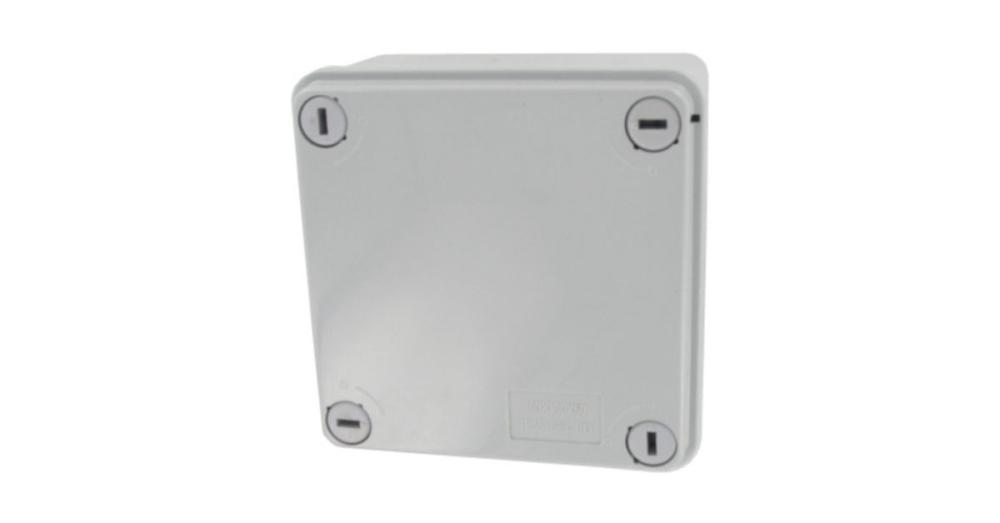
Outdoors, or anywhere damp or dusty, use an IP-rated box. The first digit of the IP code is protection against solids and the second against water: IP44 resists splashing, IP55 and IP56 resist water jets, and IP66 resists powerful jets. See our IP rating chart for the full scale.
- Deligo IP56 weatherproof enclosure: self-extinguishing ABS with a hinged lid, available in several sizes.
- Hensel 6mm² cable junction box: IP66 polypropylene with screw connections and a quick-locking lid.
- Wiska IP55 junction box: a compact enclosure for outdoor and damp locations.
A box only keeps its IP rating if every cable entry is sealed. Use the right cable glands or grommets, fit the box with entries facing down where possible, and never leave knock-outs open.
How to install a junction box safely
These are the steps a competent person follows. Always work to BS 7671 and the box maker’s instructions.
- Isolate and prove dead. Switch off and lock off the circuit at the consumer unit, then prove it dead with an approved voltage tester that you check on a known live source before and after.
- Choose the right box. Match the rating, number of terminals, cable size and IP rating to the job, and decide whether it needs to be maintenance-free.
- Fix the box securely. Screw it to a joist, stud or batten, not just to plasterboard or left loose in a void.
- Prepare the cables. Bring the outer sheath inside the box, strip only as much insulation as the terminal needs, and sleeve bare earth conductors green and yellow.
- Make the connections. Group like with like: lives together, neutrals together, earths together. Tighten screw terminals firmly, or push conductors fully home in push-in connectors.
- Relieve strain. Use the cord grips or clamps so no pull reaches the terminals, and clip the cables either side of the box.
- Close and seal. Fit the lid, seal any unused entries, and keep the box accessible unless it is marked MF.
- Test. Check continuity of the protective conductor, polarity and insulation resistance before restoring the supply.
Safety: Never work on a circuit you have not isolated and proved dead. Overfilled boxes, loose terminals and unsheathed cores inside a box are common causes of overheating and fires. If in doubt, use a qualified electrician.
For tidy routes in and out of the box, see our guide to cable management solutions, and for the basics of circuits, our guide to electrical wiring.
When should you use an electrician?
Use a qualified electrician for any job you are not fully confident with. In particular:
- New circuits and any work in bathrooms or other special locations, which can be notifiable under Part P in England and Wales.
- Republic of Ireland: controlled works, such as new circuits, must be done and certified by a Registered Electrical Contractor (REC).
- High-current circuits, such as showers, cookers and EV chargers.
- Signs of a problem: a warm or discoloured box, a burning smell, buzzing, or lights that flicker on a circuit with a junction box.
Wherever you are, the work must meet BS 7671 (I.S. 10101 in Ireland) and be tested. Check current regulations where you live.
Key takeaways
- A junction box is an enclosure that safely houses cable joints and protects them from damage and contact.
- BS 7671 requires every joint to be accessible, unless it is maintenance-free (marked MF to BS 5733) or another permitted permanent joint.
- Lever and push-in connectors still need an enclosure; a connector alone is not a junction box.
- 20A boxes suit lighting circuits and 30A boxes suit socket circuits; avoid joints on high-current circuits.
- Use an IP-rated box with sealed glands outdoors, and fix every box securely with the sheath inside.
- Isolate, prove dead and test, and use an electrician for notifiable or high-current work.
Choosing the right junction box
So, what is a junction box? It is the safe home for every joint in your wiring. Choose a screw-terminal box where it will stay accessible, an MF junction box where it will be hidden, the right amp rating for the circuit, and an IP-rated enclosure outdoors. Fit it securely, seal the entries and test the circuit, and call an electrician when the job goes beyond simple work.
Shop junction boxes and connectors
Screw-terminal and IP-rated junction boxes, lever connectors and enclosures from Deligo, Hensel, Knightsbridge, Selectric and Wiska. Trade prices, next working day delivery across NI & ROI on in-stock orders before 5pm.
Shop junction boxes Shop lever connectorsNeed help choosing? Call our team on 028 8675 1515 (048 from ROI), Monday to Friday, 8am–5pm.
FAQs
What is a junction box used for?
A junction box is an enclosure that houses the connections where cables are joined or branched, for example to extend a lighting circuit or add a spur. It protects the terminals from damage and contact, holds the cables firmly and contains any heat or sparks if a connection fails.
Do junction boxes have to be accessible?
Yes, in most cases. BS 7671 requires every connection to be accessible for inspection, testing and maintenance. The main exception for everyday wiring is a maintenance-free (MF) junction box or connector that complies with BS 5733 and is marked MF, which can be buried in a wall, floor or ceiling.
Can I use Wago or lever connectors without a junction box?
No. Lever and push-in connectors join the conductors, but they must still be fitted inside a suitable enclosure such as a junction box, accessory box or the fitting itself. Some maintenance-free junction boxes use push-in connectors inside, but the box, not the connector alone, provides the enclosure.
What is the difference between a 20A and a 30A junction box?
The rating is the maximum current the terminals are designed to carry. 20A boxes are typically used on lighting circuits, while 30A boxes are the common choice for socket circuits using 2.5mm² cable. Always pick a box rated for the circuit and with terminals that suit the cable size.
Can you put a junction box in a loft?
Yes. Fix the box securely to a joist or a batten, keep it clear of insulation where possible, and make sure you can still reach it to inspect it. If it will be covered or hard to reach, use a maintenance-free box marked MF to BS 5733 instead.
Do I need an electrician to fit a junction box?
Simple like-for-like work can be done by a competent person, but it must meet BS 7671 and be tested. New circuits and work in bathrooms can be notifiable under Part P in England and Wales, and controlled work in Ireland needs a Registered Electrical Contractor. If in doubt, use a qualified electrician.