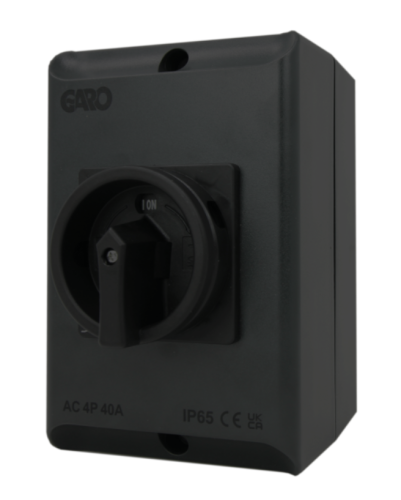
Isolators are switches that disconnect a circuit or a whole board from its supply so work can be carried out with the conductors safely de-energised. Our stock covers DIN rail main switch isolators, including the Garo 100A 2 pole mains isolator, the Live Electrical 2 pole 100A main switch and the GSV4100 100A 4 pole isolator for three phase boards.
Open a trade account for trade pricing, then order in-stock isolators before 5pm on a weekday for next working day delivery across NI and ROI.
A modular isolator is the main switch inside a consumer unit or distribution enclosure. It has no overcurrent protection of its own; its job is to break every live conductor in one action so the board can be made safe.
Number of poles
2 pole (double pole) - switches line and neutral on a single-phase supply. This is the usual main switch for domestic consumer units and small sub-boards.
4 pole - switches three lines and neutral on a three phase supply, such as the GSV4100, which takes up four modules of DIN rail.
Key specifications to check
Rated current - should be at least equal to the rating of the upstream protective device and the maximum demand of the board. 100A is common for incoming supplies.
Module width - confirm you have enough free DIN rail space in the enclosure.
Manufacturer compatibility - pick an isolator designed for the board you are using so it lines up with the busbar and cover.
Installation tips
Isolators should be fitted by a competent electrician, with the supply isolated upstream at the cut-out before any work starts. Tighten terminals to the manufacturer's torque values, label the switch clearly and test the installation to current wiring regulations. For larger loads or standalone isolation of plant, consider our boxed and rotary TP&N isolators and switch fuses, and see our consumer unit boards and enclosures for a board to house a modular isolator. Spare DIN rail and terminal blocks are also in stock.
Buying isolators from Meteor
Meteor Electrical is a family-run wholesaler based in Cookstown, Co. Tyrone, with depots in Cashel and Saggart. Orders over £30 / €35 ex VAT ship free, and credit accounts are available subject to approval. Call 028 8675 1515 (048 from ROI) for help choosing a switch.
Isolators are devices that isolate a particular circuit for maintenance and to prevent currents from passing through. Isolators are designed to allow maintenance work to be safely carried out.
What does an Isolator Switch do?
The main purpose of an isolator switch is to isolate the electrical circuit from the main power source to allow maintenance and repair work to be safely carried out. Isolator switches prevent hazards such as electric shocks and reduce life-threatening injuries.
What are double pole isolator switches?
Double pole isolator turns both live and neutral lines off. The double pole isolator is designed to allow specific appliance to be powered down to allow testing and maintenance tasks to be carried out safely. They are more commonly used for high power fixed wiring appliances including cookers and electric showers.
Where are Isolator Switches commonly used for?
Isolator switches are commonly used for most applications especially in the kitchen. Common appliances that use isolator switches are extractor fans, showers, refrigerators, air conditioners, ovens and dishwashers. Small appliances such as kettles, toasters and microwaves don’t require an isolation switch and can be used with wall sockets.
Where should an Insulator Switch be located?
Insulator switches installed in the wrong place can be potentially very dangerous. Isolator switches must be located close to the appliance and must be within reach to allow easy access for maintenance. These requirements are set to ensure the safety of everyone within the building.
Who can fit an isolator switch?
An experienced and qualified electrician will fit your isolator switch. If you have no experience dealing with electrical outlets, it is advised to contact your local electrician to prevent any damages and hazards to your home.
Does a Fridge need an isolator switch?
Yes, fridges and freezers require isolator switches. The reason is to ease the challenges with maintenance and repairs. It is required to an isolator switch as most freezers and fridges have sockets which aren’t accessible due to the heavy appliance. Therefore having an isolator switch will make it easier to access and will be safer too.
Where should the fan isolator be installed?
Fan isolator is usually installed above the door. The reason is to prevent people mistaking the fan as the light switch.
What is the difference between a 2 pole and a 4 pole isolator?
A 2 pole isolator switches line and neutral on a single-phase supply, while a 4 pole isolator switches all three lines plus neutral on a three phase supply. Choose 2 pole for typical domestic consumer units and 4 pole for TP&N boards. Using the correct type ensures every live conductor is broken when the switch is off.
Will a modular isolator fit any consumer unit?
Not always - modular isolators clip onto standard DIN rail, but the busbar connection, cover cut-out and terminal positions vary between manufacturers. For a correct fit, use an isolator made for the specific board range, such as a Garo isolator in a Garo enclosure. Check the module width and the manufacturer's compatibility list before ordering.
Is an isolator switch the same as a circuit breaker?
No, an isolator only switches the supply on and off and does not trip on overload or short circuit. A circuit breaker such as an MCB or RCBO detects faults and disconnects automatically. In a consumer unit the isolator acts as the main switch, while the breakers downstream protect the individual circuits.