
Information
What Is the Best Solar Security Lighting for Your Property? A Complete Trade and Buyer’s Guide
Quick Answer: The most dependable solar security lighting pairs monocrystalline silicon panels alongside high-capacity lithium batteries. These standalone units need zero mains cabling — relying instead on passive infrared sensors to throw bright instant light across dark access points the moment someone walks into range.
Solar security lighting has come a long way since the days of cheap plastic garden markers. We now have high output, reliable security lighting infrastructure in operation year-round across the UK. The right luminaire specification will stop winter failures and eliminate the need for expensive site visits. The installer has to know the battery chemistry, the panel wattage and the PIR (passive infrared) idiosyncrasies before they can even start to price the job. No one wants to be up a ladder in January changing a dead unit.
This guide gives the electrician and the facilities manager the hard specs and provides direct hardware comparisons. You'll see how to select trade grade fittings that will halve your mounting time, get your power bills down to zero and secure your property.
- Why Should You Choose Solar Security Lights Over Hardwired Alternatives?
- What Are the Key Technical Specifications to Look For?
- How Do You Optimise PIR Motion Sensors for Maximum Security?
- Where Are the Best Locations to Install Solar Security Lights?
- Which Are the Best Solar Security Lights for Your Next Project?
- Key Takeaways
- Conclusion: Upgrade Your Outdoor Security with the Best Solar Lighting Solutions
- Frequently Asked Questions (FAQs) About Solar Security Lighting
Why Should You Choose Solar Security Lights Over Hardwired Alternatives?
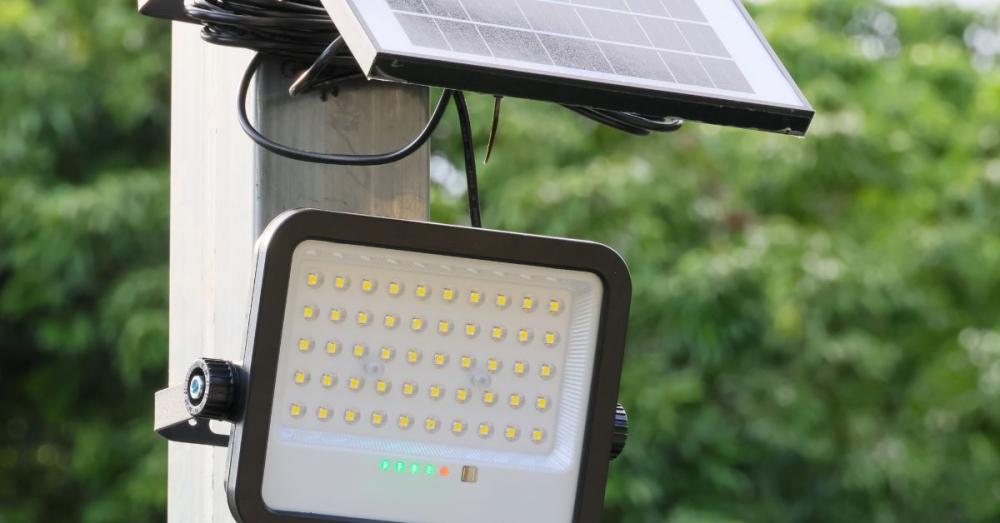
Simplifying Installation and Eliminating Trenching Costs
Mains-fed floodlights demand brutal groundwork. Digging through tarmac car parks or routing steel-wire armoured cable out to distant perimeter fences eats up labour budgets fast. Hiring a mini-digger and making good on concrete surfaces often costs three times more than the actual lamps.
Modern solar security lights sidestep that mess completely — giving instant perimeter defence around isolated outbuildings, storage compounds, and wide parking bays without opening a single trench. You bolt the bracket to the brickwork, aim the collector and walk away.
Practical site advantages include:
- The existing tarmac, block paving and landscaped borders are all left as they are.
- Distribution boards need no spare ways and no additional RCBOs.
- Temporary construction compounds get working light in 20 minutes flat.
- Grid blackouts can't touch your perimeter - your outdoor lighting UK installation will be running absolutely fine when the street goes dark.
Zero Running Costs and Carbon Reduction
Monthly utility overheads bother every commercial estate manager. Pulling free energy from daylight wipes out ongoing electricity bills while helping corporate tenants hit strict carbon-reduction targets. Removing twenty mains floodlights from a warehouse circuit shaves hundreds of pounds off annual meter readings.
Switching to solar security lighting shields property portfolios against erratic energy tariffs — delivering a fast payback period for building owners.
Source - NexNest Picks
What Are the Key Technical Specifications to Look For?
Lumen Output and Colour Temperature (CCT)
A soft 3000K warm white glow looks pleasant enough beside a pub beer garden. It fails miserably at picking out number plates or faces on a security feed. Proper commercial security lighting needs a punchy 6000K daylight beam. Cold white light creates sharp contrast on digital CCTV sensors and startles trespassers the second it snaps on. Dark haulage yards, loading bays, and long commercial driveways need at least 1000 lumens of raw output to clear away deep shadows.
| Metric | Ambient Landscape Fitting | Commercial Security Lighting |
|---|---|---|
| Light Output | 300 to 800 lumens | 1000+ lumens |
| Light Appearance | 3000K Warm White | 6000K Crisp Daylight |
| Photovoltaic Layer | Polycrystalline Silicon | Monocrystalline Silicon |
| Energy Cell | Traditional NiMH | High-Density Lithium-Ion |
| Motion Technology | Simple Twilight Switch | Adjustable PIR Sensor |
Monocrystalline Panels and Lithium-Ion Batteries
Cheap wholesale imports will typically be a mix of low-grade polycrystalline panels with rather old nickel metal hydride battery packs which are dead by November in the cold. Trade installations will be monocrystalline silicon collectors wired into lithium ion or lithium iron phosphate cells. The monocrystalline wafers will pick up the diffuse light through the thick grey cloud cover which is the norm across the UK in winter.
Lithium chemistry will cope with the deep discharge cycles and the freezing nights without the voltage dropping at all and the luminaire will be firing right through until dawn.
How Do You Optimise PIR Motion Sensors for Maximum Security?
Detection Range and Angle Adjustments
A sensor that fires every time a delivery lorry passes or a stray fox crosses the yard drains the battery before midnight. Careful PIR calibration saves stored charge strictly for real threats. Most trade-rated motion heads read heat signatures across a 120-degree fan out to 8 or 16 metres. Wind-blown bushes and boiler flues pumping out warm steam will also fool a poorly aimed lens.
Adjust your detector using the following sequence:
- Turn the sensitivity dial down halfway whenever the lens overlooks a busy public footpath or road.
- Tilt the sensor housing slightly downward so it watches the gate threshold rather than neighbouring trees.
- Dial the active illumination timer back to thirty seconds — keeping the lamp on for ten minutes per trigger will flatten the battery before sunrise.
Hybrid and Dual-Mode Functionality
High-security logistics depots cannot risk a dead lamp after five straight days of winter fog. Fitting a hybrid solar powered floodlight solves that problem permanently. Dual-supply luminaires run off their internal solar battery ninety percent of the time — dropping onto a standby 230V mains trickle feed only after battery voltage dips below a safe threshold.
Clients get near-zero running costs alongside guaranteed illumination every single night of the year.
Where Are the Best Locations to Install Solar Security Lights?
Maximising Solar Panel Sun Exposure
Walk the site at midday before drilling any fixing holes. A quick compass check before fitting solar security lighting saves massive headaches later. Collector plates must face south wherever the building layout allows — staying clear of shadows thrown by chimney stacks, parapet walls, or evergreens. Even a narrow shadow across one corner of a solar panel can choke its charging current by half.
- Keep collectors clear of overhangs and deep gutter recesses.
- Stay away from greasy kitchen extract vents or dusty workshop flues that coat the glass in grime.
- Select two-piece fixtures featuring detached panels on north-facing walls.
Detached units give you a heavy extension lead between the lamp and the collector. You can bolt the floodlight inside a pitch-black courtyard while fixing the panel high up on a sunlit roof deck.
Strategic Placement for Tamper Prevention
Fix your luminaires between 2.5 and 4 metres above finished ground level. Mounting at that elevation gives the infrared lens a clean downward sweep across approaching footpaths while keeping the casing out of reach of vandals with a crowbar. Hanging a compact solar wall light outside a fire exit or bolting a heavy unit onto warehouse cladding requires solid fixings at the right height — a foundational rule for any durable outdoor lighting UK project.
Which Are the Best Solar Security Lights for Your Next Project?
1. Kosnic Aira Solar Floodlight 1400lm
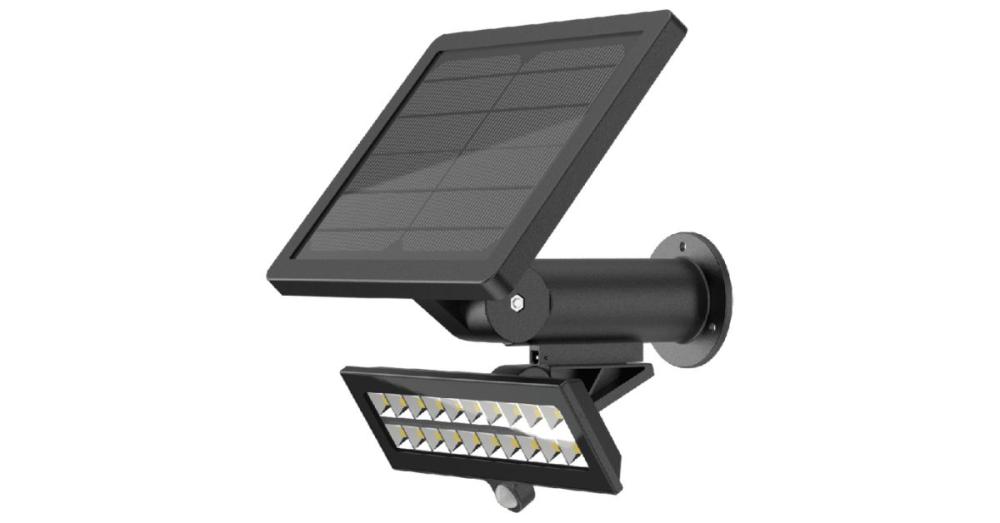
- Best For: Shaded entryways and remote perimeter walls.
- Key Features: Features a high-output monocrystalline silicon solar panel with a 2m extension cable, allowing the installer to mount the light in the dark and the panel in direct sunlight. Delivers a powerful 1400 lumens.
2. Kosnic Vega Hybrid Solar Powered Flood Light
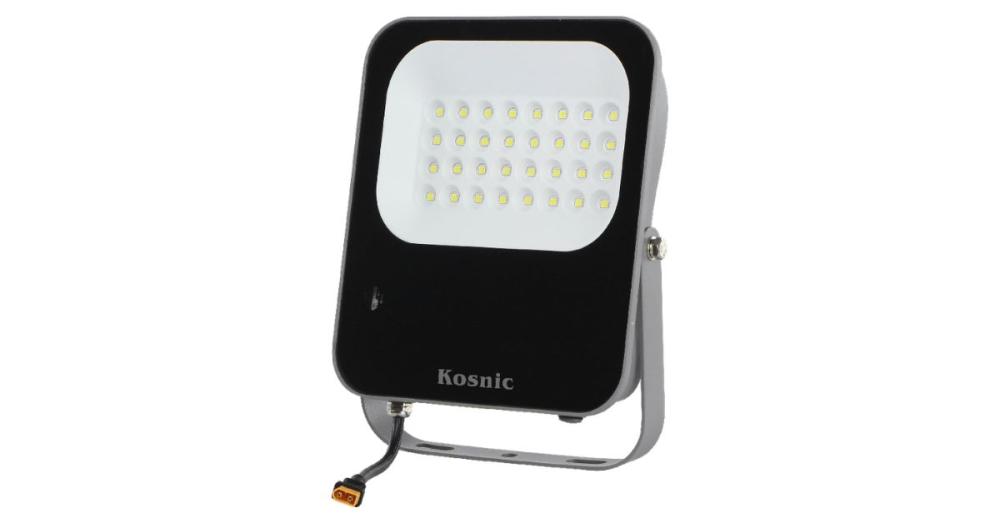
- Best For: High-security commercial sites requiring guaranteed uptime.
- Key Features: This heavy-duty solar powered floodlight utilises dual-mode operation, pulling from both solar power and a mains electricity backup for uninterrupted operation. Projects a crisp 6000K daylight beam at a wide 110-degree angle.
3. Luceco Solar Rubix Adjustable Wall Light IP65
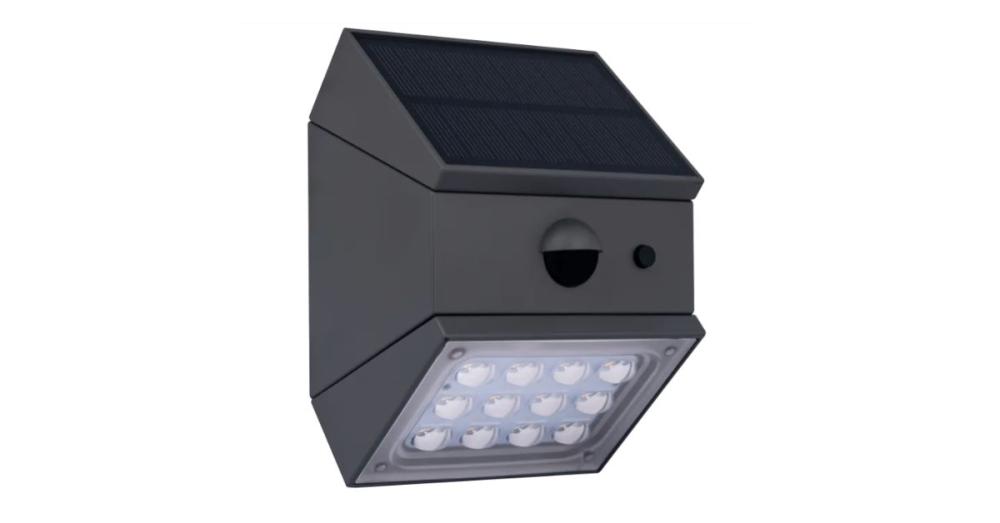
- Best For: Architectural pathways and modern residential exteriors.
- Key Features: This premium solar wall light offers selectable 3CCT colour temperatures, fully adjustable light modules for targeted illumination, and a rugged IP65 rating for ultimate weather resistance.
Key Takeaways
- Monocrystalline solar panels paired with high-capacity lithium batteries provide reliable solar security lighting, even during cloudy UK winters.
- Commercial solar security lights should deliver at least 1,000 lumens, with 6000K daylight output helping improve visibility around entrances, car parks and outdoor areas.
- Adjustable PIR motion sensors help reduce false triggers, conserve battery power and provide effective security lighting when movement is detected.
- Hybrid solar floodlights combine solar energy with mains backup, making them suitable for commercial properties that require dependable lighting during prolonged periods of poor sunlight.
- Proper installation involves positioning solar panels for maximum sunlight exposure and mounting security lights approximately 2.5–4 metres above ground for effective coverage.
- Weather-resistant, trade-grade solar security lights from brands such as Kosnic and Luceco offer different options for brightness, battery performance, durability and installation requirements.
Conclusion: Upgrade Your Outdoor Security with the Best Solar Lighting Solutions
Specifying reliable solar security lighting comes down to matching high lumen output against battery endurance and sensible sensor adjustment. Two-piece units and hybrid mains-backup circuits easily overcome awkward building shadows and bleak winter weather, giving property owners dependable off-grid protection without the groundwork bill.
Pricing your next exterior lighting upgrade requires an electrical distributor with deep technical knowledge and dependable inventory. Meteor Electrical serves electrical contractors and facilities managers as a premier wholesale partner throughout the UK and European markets.
Browse our complete range of high-performance Solar Security Lights at Meteor Electrical today to lock in competitive trade rates, draw on expert technical advice, and get rapid next-day dispatch directly to your job site!
Explore Solar Security Lighting at Meteor Electrical
Browse solar lighting options for outdoor security, commercial properties and your next electrical installation.
Frequently Asked Questions (FAQs) About Solar Security Lighting
1. Do solar security lights still work reliably in the winter?
Yes. Quality fittings built with monocrystalline collectors and modern lithium power cells charge effectively under grey skies — storing enough energy to cover long winter nights.
2. How long do the batteries in solar security lights last?
Industrial-grade lithium cells typically deliver three to five years of nightly cycling before natural chemical wear requires a replacement battery pack.
3. Can you install a solar panel away from the actual light fixture?
Yes. Split-format solar security lighting includes a dedicated extension cable — enabling installers to fit the lamp inside a dark alley while positioning the collector in clear sunlight.
4. What is the best IP rating for outdoor solar security lights?
Select a minimum rating of IP65. An IP65 seal certifies the casing as completely dust-tight and capable of shrugging off driving rain and direct hosepipe spray.
5. How high should I mount a solar PIR security light?
Fixing the luminaire between 2.5 and 4 metres up gives the motion sensor the best detection geometry while putting the unit out of reach from casual vandalism.