
Information
3 Core and Earth vs Twin and Earth: 2-Way Lighting, Sizes and Colours
Updated October 2026 · Meteor Electrical guides · 9 min read
Quick answer: Twin and earth has two insulated cores (brown and blue) plus an earth, and wires most UK circuits. 3 core and earth has three cores (brown, black and grey) plus an earth, and is used where an extra conductor is needed, mainly between the switches in 2-way lighting, where black and grey act as strappers, and for fan isolator feeds. Both are commonly 1.0 or 1.5mm for lighting.
Choosing between 3 core and earth and twin and earth is simple once you know what each extra core does. This guide is for electricians, facilities managers and informed homeowners. It explains the difference, the 3 core and earth colours, how the cable is used in 2-way lighting and fan isolator feeds, and which size to choose.
For a wider look at all cable types, see our guide to the types of electrical wiring and cables.
In this guide
- What is the difference between 3 core and earth and twin and earth?
- What are the 3 core and earth colours?
- How is 3 core and earth used in 2-way lighting?
- Do you need 3 core and earth for a fan isolator?
- What size 3 core and earth do you need?
- Which cable should you use for each job?
- 3 core and earth is not the same as 3 core flex
- Recommended cables
- FAQs
What is the difference between 3 core and earth and twin and earth?
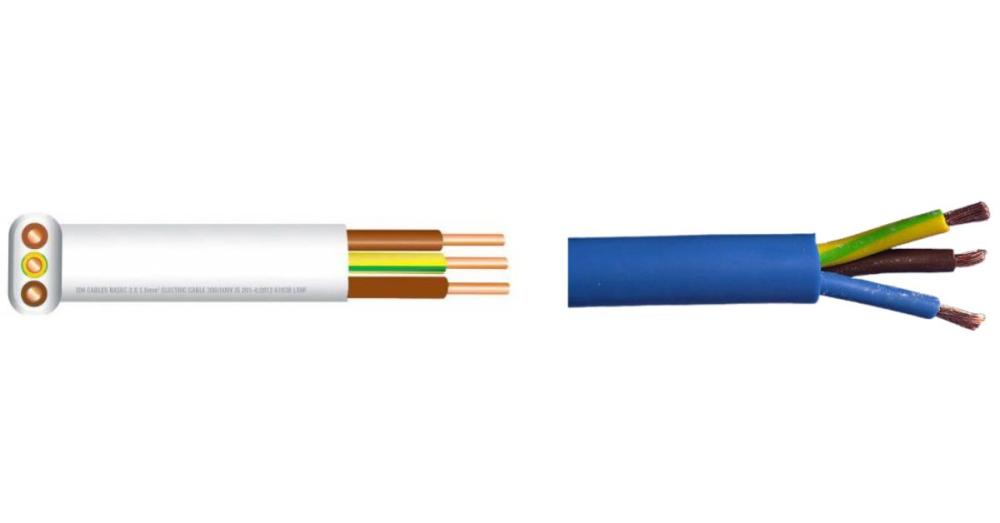
Both cables are flat, PVC or LSZH sheathed cables for fixed wiring, with a bare circuit protective conductor (CPC) between the insulated cores. The difference is the number of insulated cores: twin and earth has two, while 3 core and earth has three.
| Feature | Twin and earth | 3 core and earth |
|---|---|---|
| Insulated cores | Two | Three |
| Core colours | Brown (line), blue (neutral) | Brown, black, grey |
| Earth (CPC) | Bare copper, sleeve green and yellow | Bare copper, sleeve green and yellow |
| Common codes | 6242Y (PVC), 6242B (LSZH) | 6243Y (PVC), 6243B (LSZH) |
| Common sizes | 1.0mm² to 16mm² | Mainly 1.0mm² and 1.5mm² |
| Sheath | Flat, grey PVC or white LSZH | Flat, grey PVC or white LSZH |
| Typical uses | Lighting, sockets, cookers, showers | Two-way and intermediate lighting, fan isolator feeds, some controls |
What is twin and earth cable?
Twin and earth (6242Y) has a brown line core and a blue neutral core, plus a bare earth. It is the standard cable for UK lighting, socket, cooker and shower circuits and comes in sizes from 1.0mm² to 16mm². Browse our twin and earth cable range.
What is 3 core and earth cable?
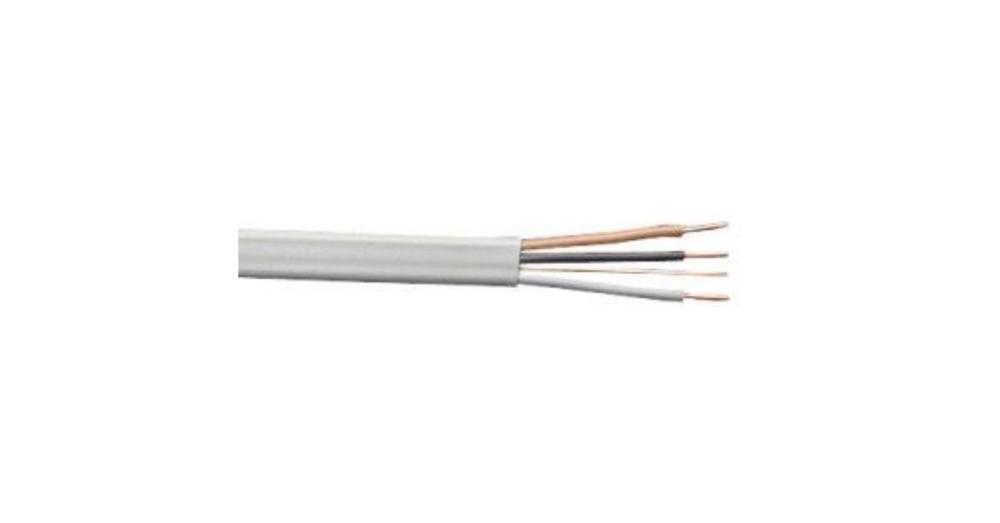
3 core and earth (6243Y) has three insulated cores, coloured brown, black and grey, plus a bare earth. The extra core is there for switching, so it is mainly used between 2-way and intermediate light switches and for extractor fans with an overrun timer. Shop our 3 core and earth cable.
What are the 3 core and earth colours?
Current 3 core and earth cable has brown, black and grey insulated cores and a bare copper CPC. Before the UK moved to harmonised colours (introduced in 2004 and required for new work from 31 March 2006), the cores were red, yellow and blue.
| Core | Current colour | Old colour | Typical use in 2-way lighting |
|---|---|---|---|
| Core 1 | Brown | Red | Switched live between the COM terminals |
| Core 2 | Black | Yellow | Strapper (L1 to L1), sleeve brown |
| Core 3 | Grey | Blue | Strapper (L2 to L2), sleeve brown |
| CPC | Bare copper | Bare copper | Earth, sleeve green and yellow |
The black and grey cores are not neutrals in 3 core and earth. BS 7671 requires conductors to be identified by their function at terminations, so:
- Sleeve black and grey cores with brown when they are used as line conductors or strappers.
- Sleeve a core with blue if it is used as a neutral, for example in a fan feed.
- Always sleeve the bare CPC with green and yellow where it is terminated.
Pro tip: Brown, blue and green and yellow sleeving or marker tape is cheap. Fitting it at every termination makes the circuit safer and much easier for the next electrician to fault-find.
How is 3 core and earth used in 2-way lighting?
2-way lighting lets you switch one light from two places, such as the top and bottom of the stairs. Each 2-way switch has three terminals: COM (common), L1 and L2. The two switches are linked by two strapper conductors, which is why the cable between them needs an extra core.
In the common conventional method, twin and earth runs from the light to the first switch, and 3 core and earth runs between the switches. The outline below shows the idea; always follow the switch manufacturer’s diagram and the circuit design.
- Isolate the lighting circuit at the consumer unit and prove it dead with a voltage tester.
- At switch 1, connect the twin and earth brown (permanent live) to COM.
- Join the twin and earth blue (the switched live, sleeved brown) to the brown core of the 3 core and earth with a suitable connector, so the switched live continues to switch 2.
- Connect the black core to L1 and the grey core to L2 at switch 1. These are the strappers; sleeve them brown.
- At switch 2, connect the brown core to COM, black to L1 and grey to L2.
- Sleeve every CPC green and yellow and connect it to the earth terminal of each switch or metal back box.
- Test the circuit (continuity, insulation resistance and polarity), then check the light works from both switches.
For three or more switching points, an intermediate switch is fitted between the two 2-way switches, with 3 core and earth to each side. The strappers pass through the intermediate switch, which swaps them over. If you are adding a dimmer to a 2-way circuit, see our guide: Can I install dimmer switches in my home?.
Safety: Lighting circuits can have borrowed neutrals or feeds from other circuits. If the wiring does not match what you expect, stop and get a qualified electrician. New circuits and work in some locations are notifiable under Part P in England and Wales, and in Ireland work should be done by a Registered Electrical Contractor.
Do you need 3 core and earth for a fan isolator?
A bathroom or kitchen extractor fan with an overrun timer needs three conductors at the fan: a permanent live to power the timer, a switched live from the light switch to start it, and a neutral. A triple-pole fan isolator switches off all three for safe maintenance.
The feed to the isolator usually comes from the lighting circuit, and 3 core and earth then runs from the isolator to the fan:
- Brown: permanent live.
- Black, sleeved brown: switched live from the light.
- Grey, sleeved blue: neutral.
- Bare CPC, sleeved green and yellow: earth, terminated at the isolator and at the fan where it has an earth terminal.
A basic fan without a timer only needs a switched live and a neutral, so twin and earth can be used. Fan wiring varies, so always check the fan’s instructions and the bathroom zone rules. See our extractor fans and our guide to the types of bathroom extractor fan.
What size 3 core and earth do you need?
3 core and earth is mainly made in 1.0mm² and 1.5mm², which suit lighting circuits on a 6A breaker. 1.0mm is enough for most LED lighting circuits, while 1.5mm gives more margin for long runs, voltage drop and cable passing through insulation. Match the 3 core to the size of twin and earth on the rest of the circuit, and let the BS 7671 design confirm the size.
For sizes on other circuits, see our guide to the best electrical cable for home wiring.
Which cable should you use for each job?
| Job | Cable to use | Why |
|---|---|---|
| One-way light switch | Twin and earth | Only line, switched line and earth are needed at the switch |
| Two-way lighting, stairs or landing | Twin and earth to switch 1, 3 core and earth between switches | Two strappers plus the switched live are needed between switches |
| Intermediate switching (three or more switches) | 3 core and earth between every switch | The strappers run through each intermediate switch |
| Extractor fan with overrun timer | 3 core and earth from the fan isolator to the fan | The fan needs permanent live, switched live and neutral |
| Socket circuits | Twin and earth | Standard line, neutral and earth circuit |
| Cooker or shower | Twin and earth, larger sizes | 3 core and earth is not made in these sizes |
In practice, most homes need both. Twin and earth does most of the wiring, and a coil of 3 core and earth covers the stairs, landings, long hallways and fans.
3 core and earth is not the same as 3 core flex
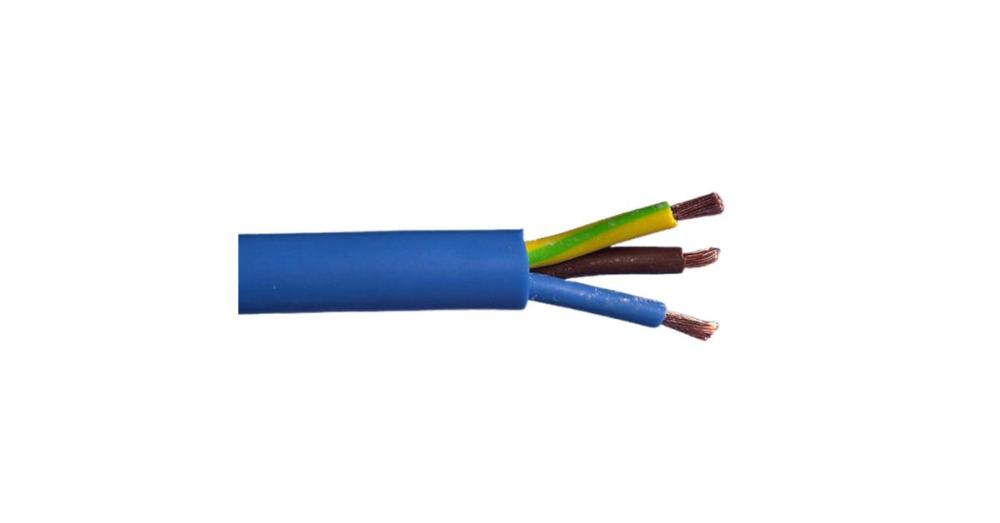
“3 core” flex, such as 3183Y or arctic flex, has brown, blue and green and yellow cores: line, neutral and earth. The earth is one of the three cores. It is a fine-stranded flexible cable for appliances, tools and outdoor equipment, not for fixed wiring or 2-way switching.
Our 2.5mm 3 core arctic flex stays flexible in cold conditions, which suits outdoor tools and site equipment. See all our flexes for other types.
Recommended cables for lighting and domestic wiring
PVC/PVC 1.5mm 3 core and earth cable (100m coil)
A 6243Y-type 3 core and earth with brown, black and grey cores and a bare earth, for 2-way and intermediate lighting and fan feeds. Shop 1.5mm 3 core and earth. A 1.0mm 3 core and earth version and a low smoke 6243B 1.5mm 3 core and earth are also available.
6193B 2.5mm LSF twin and insulated earth (100m)
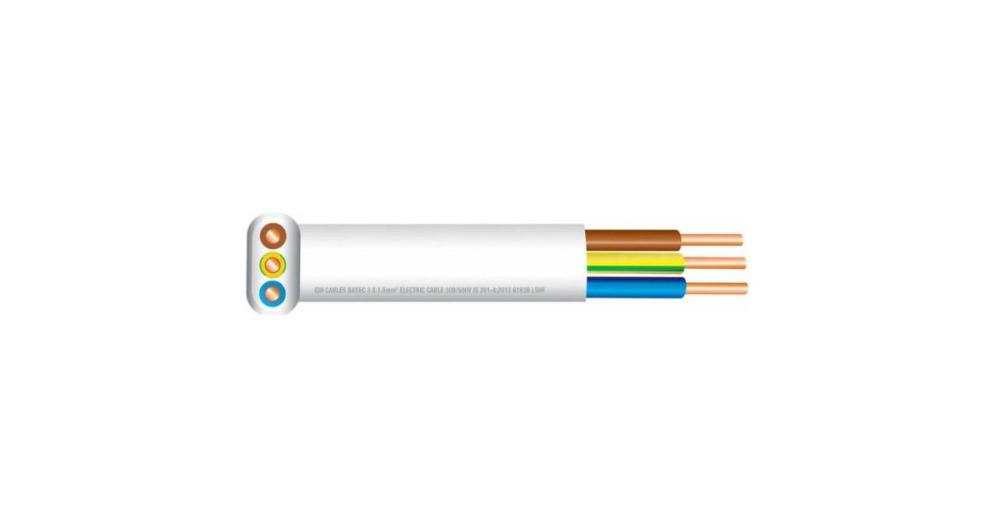
A low smoke twin and earth with an insulated green and yellow earth core, for general fixed installations such as socket circuits. Shop 2.5mm LSF twin and insulated earth.
6193B 4.0mm LSF twin and insulated earth (100m)
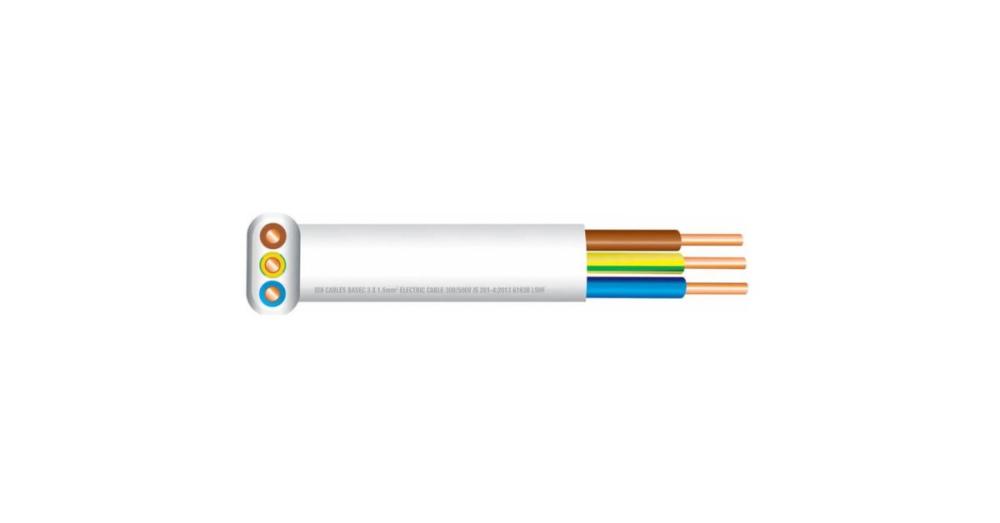
A larger low smoke twin and earth for circuits that the design calls for in 4.0mm², such as 32A radial socket circuits. Shop 4.0mm LSF twin and insulated earth.
Before you buy: quick checklist
- Match the cable to the circuit: twin and earth for standard circuits, 3 core and earth where you need the extra core.
- Check the size against the rest of the circuit and the design.
- Choose PVC or LSZH to suit the building and the specification.
- Look for BASEC approval and the relevant British Standard on the product data.
- Order brown, blue and green and yellow sleeving and lever connectors at the same time.
Key takeaways
- Twin and earth has brown and blue cores; 3 core and earth has brown, black and grey cores. Both have a bare earth.
- Use twin and earth for most circuits and 3 core and earth between 2-way and intermediate switches.
- In 2-way lighting, black and grey are usually the strappers (L1 and L2), sleeved brown.
- Fans with an overrun timer usually need 3 core and earth from the fan isolator to the fan.
- 3 core and earth is mainly sold in 1.0mm and 1.5mm for lighting circuits.
- Sleeve every core for its function and sleeve the CPC green and yellow.
3 core and earth vs twin and earth: which should you use?
Use twin and earth for standard lighting, socket and appliance circuits, and use 3 core and earth wherever you need an extra conductor, mainly between 2-way switches and for fan isolator feeds. Know the 3 core and earth colours, sleeve each core for its function, and match the size to the rest of the lighting circuit. If you are unsure, use a qualified electrician and follow BS 7671.
Shop 3 core and earth and twin and earth
1.0mm and 1.5mm 3 core and earth plus twin and earth in every common size, in PVC and low smoke versions. Trade prices, next working day delivery across NI & ROI on in-stock orders before 5pm.
Shop 3 core and earth Shop twin and earthNeed help choosing? Call our team on 028 8675 1515 (048 from ROI), Monday to Friday, 8am–5pm.
FAQs
Can I use twin and earth for 2-way lighting?
Not for the link between the two switches. Two-way switching needs two strapper conductors plus the switched live, so the cable between the switches must be 3 core and earth. Twin and earth is still normally used for the run from the light, or junction box, to the first switch.
What are the 3 core and earth colours?
Current 3 core and earth has brown, black and grey insulated cores plus a bare earth, which must be sleeved green and yellow. In older installations, the cores are red, yellow and blue. Black and grey cores used as line conductors should be sleeved brown at each termination.
Which cores are the strappers in 2-way lighting?
In the usual method, the black and grey cores of the 3 core and earth are the strappers. They connect the L1 terminal of one switch to the L1 of the other, and L2 to L2. The brown core carries the switched live between the COM terminals, as the circuit is designed.
What size 3 core and earth do I need for lighting?
Most domestic lighting uses 1.0mm or 1.5mm 3 core and earth on a 6A breaker. 1.0mm suits most LED lighting circuits, while 1.5mm is often chosen for longer runs and to allow for voltage drop. The circuit design to BS 7671 confirms the right size.
Do I need 3 core and earth for an extractor fan?
Usually, yes, for a fan with an overrun timer. The fan needs a permanent live, a switched live from the light and a neutral, so a 3 core and earth runs from the triple-pole fan isolator to the fan. A simple fan without a timer can use twin and earth.
Can I use 3 core and earth instead of twin and earth?
It can carry line, neutral and earth if you sleeve the cores correctly, with a spare core left unused. It is not usually worth it, because 3 core and earth costs more and comes in fewer sizes. Use twin and earth for standard circuits and 3 core where you need the extra core.