
Surge Protection UK Buying Guide: 18th Edition Rules, SPD Types, and Coordination Basics
Surge Protection UK Buying Guide: 18th Edition Rules, SPD Types, and Coordination Basics
Modern domestic and commercial properties rely heavily on sensitive electronics. Everything from smart home automation systems, heat pumps, and EV chargers to commercial servers and automated production lines depends on clean, stable power. Because modern microprocessors operate at low voltages, the threat of transient overvoltages has never been more critical for building infrastructure.
For electrical contractors and facilities managers, navigating the BS 7671 regulations regarding surge protection devices (SPDs) can feel complex. Choosing the wrong device or carrying out a poor installation can lead to catastrophic hardware failure, voided manufacturer warranties, and regulatory non-compliance. A common question facing trade professionals is: "When are surge protection devices legally required for commercial buildings in the UK?"
This comprehensive buying guide breaks down current UK mandates, compares device types, and details coordination basics so you can specify the right surge protection device UK to remain safe, compliant, and dependable.
Do I Need Surge Protection? Understanding 18th Edition Regulations
The 18th Edition of the IET Wiring Regulations (BS 7671:2018+A2:2022) significantly simplified the decision-making process for installing transient overvoltage protection. Historically, electricians had to calculate a complex Calculated Risk Level (CRL). Today, the requirements are far more direct and safety-focused.
When is an SPD Mandatory in the UK?
Under Regulation 443.4.1 of BS 7671, surge protection devices (SPDs) must be installed where an overvoltage could result in:
- Serious injury to, or loss of, human life.
- Interruption of public services or damage to cultural heritage.
- Interruption of commercial or industrial activity.
- An impact on a significant number of co-located individuals (such as in residential care homes, hotels, or schools).
For commercial facilities, virtually every installation carries financial implications related to operational downtime or data loss, making surge protection mandatory in practice.
Domestic Installations and Risk Assessments
In single residential dwellings, protection against transient overvoltages is required unless the property owner specifically opts out. If an owner chooses not to have an SPD installed, they must provide a signed declaration confirming they accept all financial and equipment loss risks.
Because modern homes contain thousands of pounds worth of vulnerable technology, fitting consumer units with surge protection has become standard trade practice during board upgrades. Doing so guarantees BS 7671 compliance while giving homeowners complete peace of mind.
Transient Overvoltages: Lightning vs. Grid Switching
Voltage spikes generally stem from two primary sources:
- Atmospheric Surges (Lightning): Direct strikes to power lines or nearby ground strikes that induce massive voltage transients into underground electrical supply cables.
- Switching Transients (Grid & Internal): Everyday voltage spikes generated by utility grid switching or the rapid cycling of heavy inductive loads within the building, such as lift motors, air compressors, and HVAC units.
Demystifying SPD Types: Type 1, Type 2, and Type 3 Explained
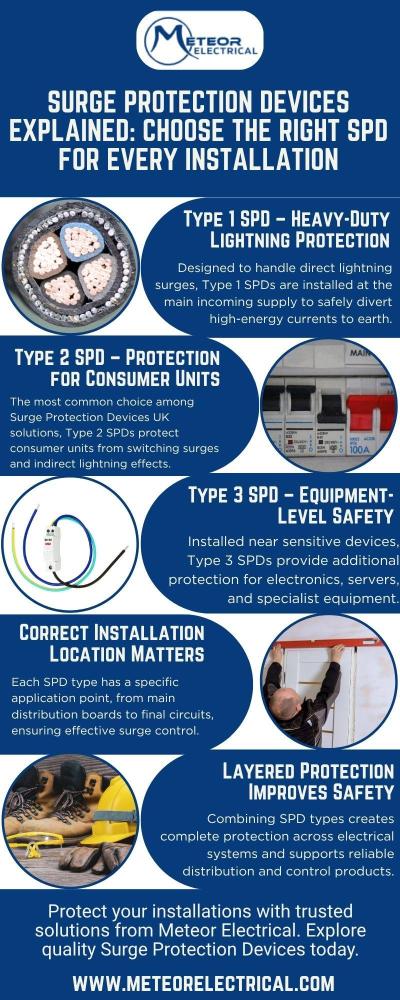
Selecting the right device requires understanding the three core classifications recognised in UK wiring regulations. Installers often ask: "What is the difference between a Type 1 and Type 2 surge protection device?" The answer lies in their discharge capacity and intended installation point.
Type 1 SPDs: Protection Against Direct Strikes
Type 1 devices (lightning current arresters) are built to handle the intense energy of direct atmospheric lightning strikes. Tested with a 10/350 µs current waveform, they redirect immense currents safely to earth.
- Installation Location: Fitted at the origin of the electrical installation, typically in the main distribution board or primary intake panel.
- Primary Use Case: Mandatory on structures equipped with an external Lightning Protection System (LPS) or properties supplied directly by exposed overhead power lines.
Type 2 SPDs: The Standard for Consumer Units
Type 2 devices are designed to protect against indirect lightning effects and continuous switching transients. Characterised by an 8/20 µs waveform, they are the most common units used across the UK.
- Installation Location: Installed on the supply side of sub-distribution boards and standard consumer units.
- Primary Use Case: They clamp high voltage spikes down to a safe residual voltage (typically below 1.5kV). Upgrading consumer units with surge protection using Type 2 modules safeguards general lighting, power rings, and connected appliances throughout the building.
Type 3 SPDs: Localised Point-of-Use Protection
Type 3 devices offer low discharge capacity and are designed for fine-tuned protection right at the terminal equipment.
- Installation Location: Fitted downstream of a Type 2 device, mounted within socket outlets, fused spurs, or power distribution strips.
- Primary Use Case: Supplying supplementary protection for highly sensitive hardware, such as enterprise servers, lab equipment, and home audio-visual racks.
Did You Know - Up to 80% of all transient voltage spikes originate inside the building itself due to internal switching of inductive machinery, rather than external lightning strikes?
The Basics of SPD Coordination for Electricians
What is Surge Protection Coordination?
Surge protection functions best as a coordinated system rather than a single standalone unit. Coordination involves cascading Type 1, Type 2, and Type 3 devices across your electrical distribution layout.
- The upstream Type 1 unit absorbs the bulk of an extreme surge at the building origin.
- The downstream Type 2 device at the sub-board handles the remaining energy.
- Type 3 units eliminate residual micro-spikes at the load. This ensures no single device is overwhelmed, keeping let-through voltage within safe limits for connected equipment.
This ensures no single device is overwhelmed, keeping let-through voltage within safe limits for connected equipment.
Installation Best Practices and Cable Length Rules
Proper SPD installation is just as critical as choosing the correct hardware. Electricians should follow these key rules:
- The 0.5-Metre Rule: Keep total lead length (the connection from the phase conductor, through the SPD, to the main earth terminal) strictly under 0.5 metres. Shorter, straight leads reduce cable inductance, ensuring the SPD clamps overvoltages instantly.
- Minimise Cable Loops: Avoid unnecessary bends or coiling in connection cables, as sharp bends increase high-frequency impedance.
- Coordinate Backup Protection: Install appropriate upstream MCBs or backup fuses as specified by the manufacturer to prevent board failure during an end-of-life SPD event.
- Integrate with High-Grade Components: Ensure all surrounding distribution and control products (enclosures, busbars, and disconnectors) match the prospective fault current of the installation.
Key Takeaways
- SPDs protect modern electrical systems from damaging transient overvoltages affecting sensitive equipment.
- BS 7671 18th Edition defines SPD requirements for installations where overvoltage risks could cause serious damage or disruption.
- Type 1, Type 2, and Type 3 SPDs serve different roles, from lightning protection to equipment-level surge control.
- SPD coordination creates layered protection by allowing multiple devices to work together effectively.
- Proper installation matters, including short cable lengths, minimal loops, and correct backup protection.
- Choosing compliant SPDs helps reduce equipment damage, downtime, and compliance risks.
Top Trade-Rated Surge Protection Devices for Your Next Project
To ensure strict regulatory compliance and ultimate safety for your installations, here are top-tier Surge Protection Devices available at Meteor Electrical:
1. GARO Surge Protector 2 Pole Class II
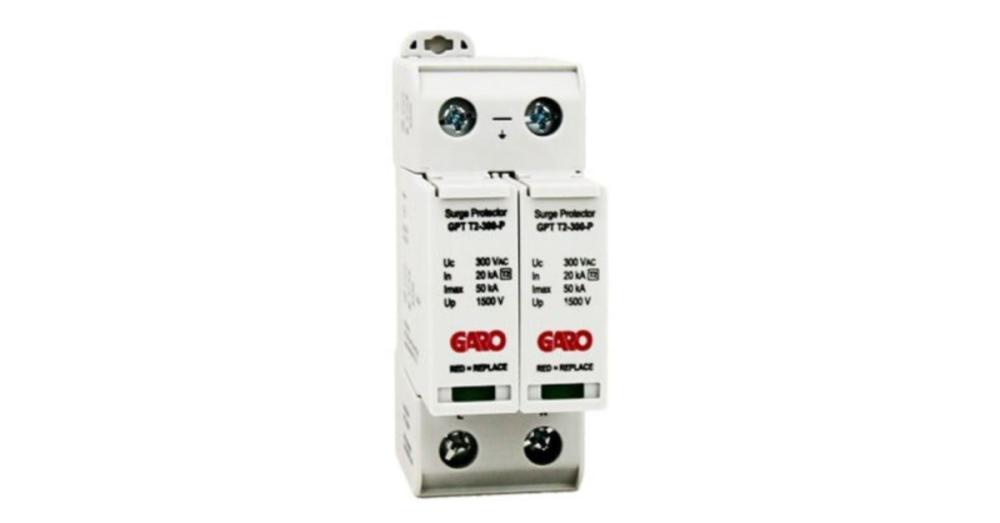
Protect your electrical systems with the GARO 2 Pole Class II Surge Protector, engineered for enhanced safety and long-lasting performance. This compact and durable device safeguards against transient overvoltages caused by lightning strikes or switching surges, making it an essential addition to residential and commercial installations.
- Mode of Protection: L-PEN
- Surge Ratings: In = 20 kA (8/20 µs)
- Protective Elements: High-energy Metal Oxide Varistor (MOV)
- Housing: Pluggable design with clear status window
- Compliance: Fully certified to IEC 61643-11:2011 and EN 61643-11:2012
Shop GARO Surge Protector 2 Pole Class II
2. Type 2 Surge Protection Device Single Module 1P+N, 20KA/40KA
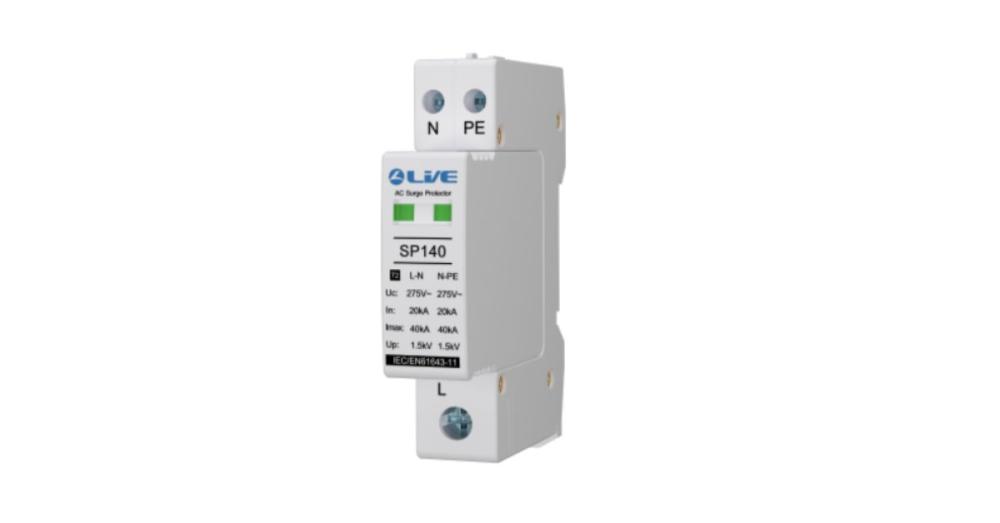
This single-module Type 2 SPD delivers dependable overvoltage defence while occupying minimal space on your DIN rail. It is an outstanding choice for compact consumer units where internal space is tight, but 18th Edition protection is mandatory.
- Product Type: 1P+N Single Module SPD
- Current Rating: 20kA nominal / 40kA maximum discharge capacity
- Device Type: Type 2 transient surge suppressor
- Compact Footprint: Single 18mm module width
- Product Code: SP1401P+N/1
Shop Type 2 Surge Protection Device Single Module 1P+N, 20KA/40KA
3. Live Electrical 4P 20KA/40KA Type 2 Surge Protection Device
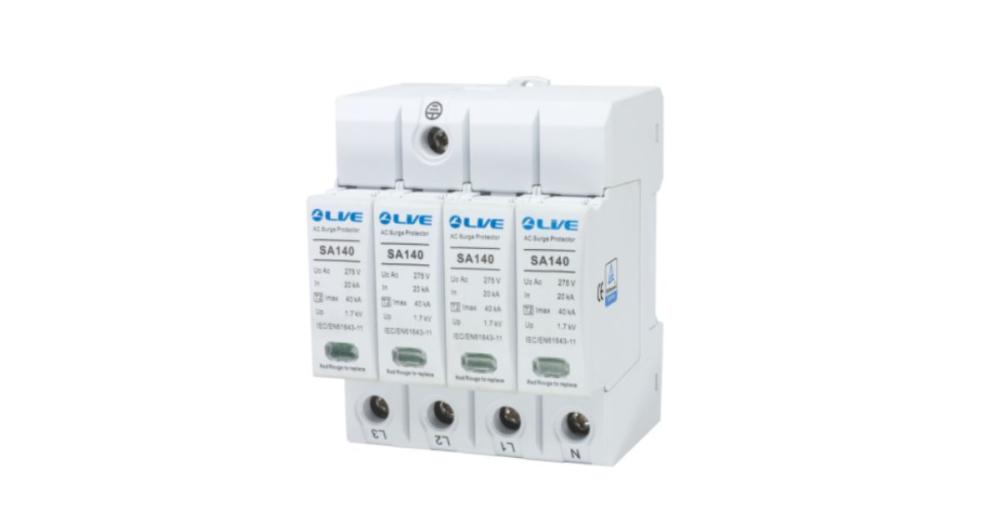
The SA440 4 Pole Type 2 Surge Protection Device is designed to protect three-phase installations from transient overvoltages caused by switching events and indirect strikes. With a nominal discharge current of 20kA and a maximum capacity of 40kA, it provides reliable 1.7kV protection for commercial and industrial boards.
- Configuration: 4 Pole Type 2 SPD for three-phase TN systems (230V/380V)
- Protection Level: 1.7kV voltage protection rating
- Visual Status Indicator: Green (Operational) / Red (Replacement Required)
- Mounting: DIN rail mounted across a compact 4-module width (72mm)
- Operating Range: Built for demanding conditions (-40°C to +85°C)
Shop Live Electrical 4P 20KA/40KA Type 2 Surge Protection Device
4. GARO SPD 2 Pole Class II Single Module – c/w Earth, Neutral & Live Cables
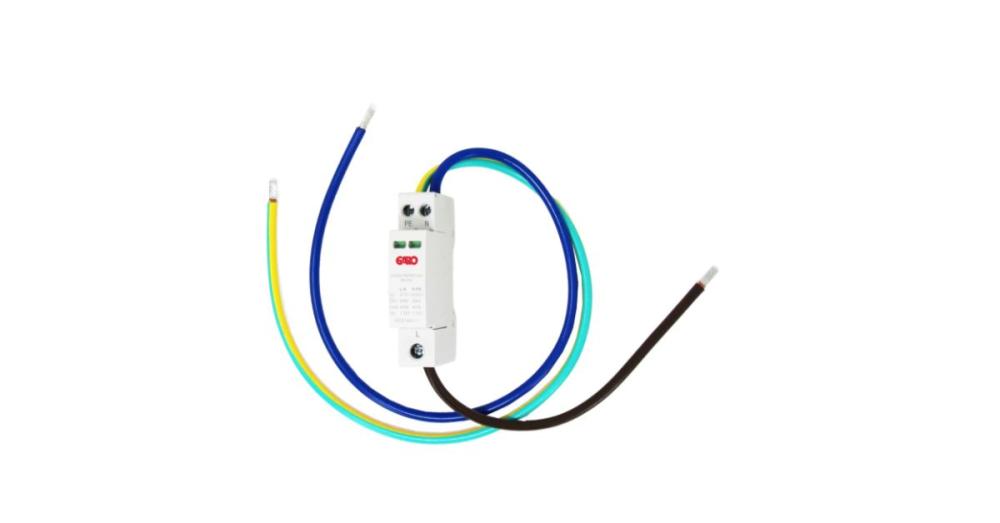
Designed as an all-in-one compact solution, this single-module SPD provides dependable transient protection while speeding up installation. Supplied complete with pre-wired Earth, Neutral, and Live cables, it ensures neat, compliant results in modern consumer units with surge protection.
- Configuration: 2 Pole Type 2 (Class II) SPD
- Space Saving: Compact single-module design preserves valuable board ways
- Complete Kit: Supplied with pre-cut Earth, Neutral, and Live connection leads
- Mounting: Standard 35mm DIN rail installation
- Application: Ideal for domestic consumer units and commercial sub-boards
Shop GARO SPD 2 Pole Class II Single Module c/w Cables
Secure Your Installations with the Right SPD from Meteor Electrical
Selecting the correct surge protection devices (SPDs) is a fundamental part of delivering safe, regulation-compliant electrical work. By identifying property risk factors, selecting the correct SPD Type (1, 2, or 3), and keeping cable lengths strictly within the 0.5-metre threshold, you protect valuable customer equipment and prevent costly maintenance callbacks.
Meteor Electrical is a leading wholesale electrical supplier for the UK and European markets, proudly serving electrical contractors and facilities managers with top-tier distribution and control products. Browse our extensive range to secure competitive trade pricing and fast delivery on all your essential electrical supplies.
Shop our complete range of Surge Protection Devices at Meteor Electrical today to keep your projects fully protected!
Frequently Asked Questions (FAQs) About Surge Protection
1) Are surge protection devices mandatory in UK homes?
Yes, under 18th Edition rules, SPDs are required in domestic properties unless the homeowner explicitly opts out in writing and accepts all liability for equipment damage.
2) Can I install a Type 3 SPD without a Type 2 SPD?
No, Type 3 SPDs have a low discharge capacity and must always be installed as a downstream supplement to an upstream Type 2 SPD.
3) How long do surge protection devices typically last?
Lifespan depends on the frequency of surges absorbed; modern SPDs feature visual indicator flags that change from green to red when the internal cartridge requires replacement.
4) How long should the cables be when installing an SPD?
The total connecting cable length between the supply, the SPD, and the earth bar must be kept as short and straight as possible, strictly under 0.5 metres.
5) Does a Type 2 SPD protect against direct lightning strikes?
No, Type 2 SPDs protect against indirect strikes and switching transients; structures with lightning rods or overhead power feeds require a Type 1 SPD.