
How to Fit an IP65 Bulkhead Safely and Correctly: A Practical Step-by-Step Guide

How to Fit an IP65 Bulkhead Safely and Correctly: A Practical Step-by-Step Guide
Getting IP65 Bulkhead installation right keeps people safe, reduces nuisance call backs and protects your reputation on site. IP65 means a fitting is completely dust-tight and protected against low-pressure water jets from any direction, thanks to the “6” for dust exclusion and the “5” for water jet resistance in the IP rating chart.
This guide is catered towards qualified electricians and contractors who want a clear, practical process they can rely on. By the end, you will have a clear method for safe IP65 Bulkhead installation, testing and handover that works across a range of light fittings and environments.
IP65 Bulkhead Basics and Common Applications

What IP65 Actually Means for Bulkhead Lighting Performance
An IP65 bulkhead is designed to keep dust out completely while withstanding low-pressure water jets, which is ideal for exposed or damp locations. In practice that means the enclosure, seals and cable entries all work together so the gear and lamp or LED module remain protected from contaminants that shorten life or cause faults.
Typical Applications of IP65 Bulkheads: Car Parks, Exterior Walkways, Plant Rooms, and Damp Areas
IP65 bulkheads are commonly used in car parks, service yards, exterior walkways and building perimeters where rain, spray and dust are routine. They also work well in plant rooms, stairwells, garages and similar semi‑enclosed areas that need robust, weatherproof lighting and good vandal resistance.
Pre‑Installation Planning and Product Selection

Choosing the Right IP65 Bulkhead: LED vs Fluorescent, Emergency, and Sensor Options
Most electricians now favour LED bulkhead lights over fluorescent because they cut energy use, start instantly and need less maintenance. Where you still find LED tube lighting and lamp combinations in tired bulkheads, it is often more cost‑effective to upgrade the complete fitting.
At design stage, decide if the client needs:
- Emergency IP65 bulkheads
- Microwave or PIR sensor control
- Corridor function dimming for low‑level background light
Checking Supply, Circuit Protection, and Cable Routes Before Installation
Walk the route and confirm supply characteristics, circuit protection type and earthing arrangement before unpacking any fittings. Check that the circuit can handle the additional load and that existing terminations, junctions and accessories are sound.
Inspect cable routes for:
- UV exposure
- Risk of mechanical damage
- Segregation from data or control cables
When purchasing from a wholesale outdoor lighting accessories supplier, confirm that glands, fixings and boxes are suitable for the environment and maintain the required IP rating.
Tools, Test Instruments, and PPE Checklist for Professional Electricians
Before you begin, make sure you have:
- Calibrated voltage indicator and proving unit
- Insulation resistance tester and continuity tester
- Appropriate drills, bits and fixings for the mounting surface
- IP‑rated cable glands and grommets suitable for the cable type
- PPE including eye protection, gloves and suitable footwear
Having everything to hand helps each IP65 Bulkhead installation go smoothly and reduces the temptation to compromise on glands, seals or fixings just to get the job done.
How to Fit an IP65 Bulkhead Step-by-Step Guide
A structured process keeps every job consistent, from a single fitting to a full run of weatherproof lighting.
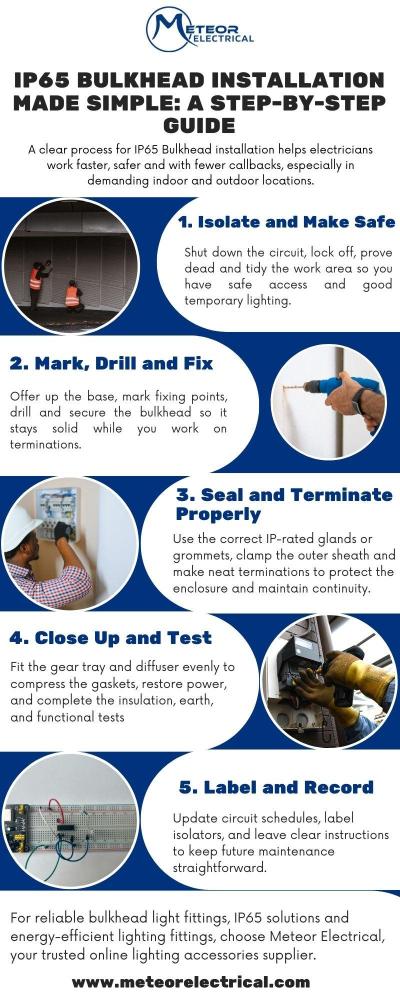
Step 1: Isolate the Circuit, Prove Dead, and Prepare the Work Area
Follow your safe isolation procedure, lock off, prove your tester, then prove the circuit dead. Clear the work area, set up safe access and ensure lighting levels are adequate while power is off.
Step 2: Mark Fixing Points, Drill, and Mount the Bulkhead Body
Offer up the base, mark fixings, and ensure cable entries are positioned to maintain IP integrity. Drill with appropriate bits, plug or anchor as needed, then secure the body firmly so it will not move when cables are terminated.
Step 3: Make Moisture‑Resistant Connections: Glands, Grommets, and Terminations
Fit IP‑rated glands or grommets sized correctly for the cable, tighten locknuts and check that outer sheaths are clamped, not just the cores. Terminate conductors neatly into the terminal block, keeping bare copper within the enclosure and maintaining polarity and earth continuity.
Step 4: Secure the Diffuser, Restore Power, and Run Final Electrical Tests
Refit the gear tray if applicable, secure the diffuser or cover evenly so gaskets are compressed correctly, then restore power at the isolator. Carry out insulation resistance, earth continuity and functional tests, recording results in your test paperwork.
Step 5: Document Test Results and Label the Circuit for Future Maintenance
Mark the fitting location on circuit schedules, label isolators and leave any user instructions accessible for the client. A tidy record of each IP65 Bulkhead installation helps future troubleshooting and keeps inspection and testing straightforward.
IP65 Bulkhead Installation: Common Mistakes to Avoid
Avoid these frequent issues that undermine performance:
- Using incorrect or loose cable glands that compromise the IP65 seal
- Mounting onto uneven or crumbling surfaces so gaskets cannot seat properly
- Mixing incompatible accessories with the fitting
- Overloading existing circuits without checking total load and protective device ratings
- Neglecting periodic cleaning and inspection leading to dirt build‑up and reduced light output
When you steer clear of these, your installations look professional and perform reliably.
Source - Meteor Electrical
Get Your IP65 Bulkhead Installation Right Every Time with Meteor Electrical!
Meteor Electrical, a trusted online lighting accessories supplier, offers a broad selection of bulkhead light fittings for both indoor and outdoor projects, with robust housings, varied shapes and clip‑on trim options to suit different environments, as well as outdoor LED bulkhead lights that stand up to dust and weather while keeping running costs down.
When you are ready to buy light fittings online, choose Meteor Electrical for quality bulkheads, energy-efficient lighting fittings and matching accessories, and turn every project into a low‑hassle success story with a supplier that has your back.
FAQs
1. Can I fit an IP65 bulkhead in bathrooms, garages, and other special locations?
Yes, as long as the IP rating and zoning match the bathroom, garage or special area and you follow the manufacturer’s guidance.
2. What cable type and size should I use for IP65 Bulkhead Installations?
Choose a cable type and size suited to the circuit rating, installation method and fault level, and make sure it works with the recommended glands and terminations.
3. Do IP65 bulkheads need a specific type of MCB or RCD protection?
They usually sit on standard lighting circuits, so select MCB and RCD devices that meet required disconnection times, fault levels and any extra RCD needs in wet or outdoor locations.
4. How do I prevent condensation and water ingress in IP65 fittings over time?
Mount on a sound surface, tighten glands correctly, keep gaskets intact, avoid extra holes and advise the client to carry out quick visual checks for damage.
5. How often should IP65 bulkheads be tested, cleaned, and maintained?
Include them in routine inspection and testing, with occasional diffuser cleaning and checks on seals and fixings to keep light output and protection consistent.