
Information
Best LED Lights for a Garage Workshop in the UK: Buying Guide
Updated October 2026 · Meteor Electrical guides · 9 min read
Quick answer: For most UK garage workshops the best LED lights are 5ft or 6ft LED battens, ideally IP65 non-corrosive types if the space is dusty, damp or unheated. Aim for about 300 lux (lumens per m²) for general work and 500 lux or more over the bench. Use LED low bays or high bays only where the ceiling is above about 4 m.
Good lighting is one of the cheapest upgrades you can make to a garage or workshop. This guide explains how many lumens you need, which fittings suit which ceiling heights, what IP and IK ratings mean, and how to plan a layout that gets rid of shadows on the bench.
In this guide
- What is the best lighting for a garage workshop?
- Are LED lights better than fluorescent tubes for a garage?
- How many lumens do you need for a garage workshop?
- Which LED light fittings are best for a garage or workshop?
- What IP rating do garage lights need?
- How should you lay out garage workshop lighting?
- How do you compare LED garage lights when buying?
- Can you install garage lights yourself?
- FAQs
What is the best lighting for a garage workshop?
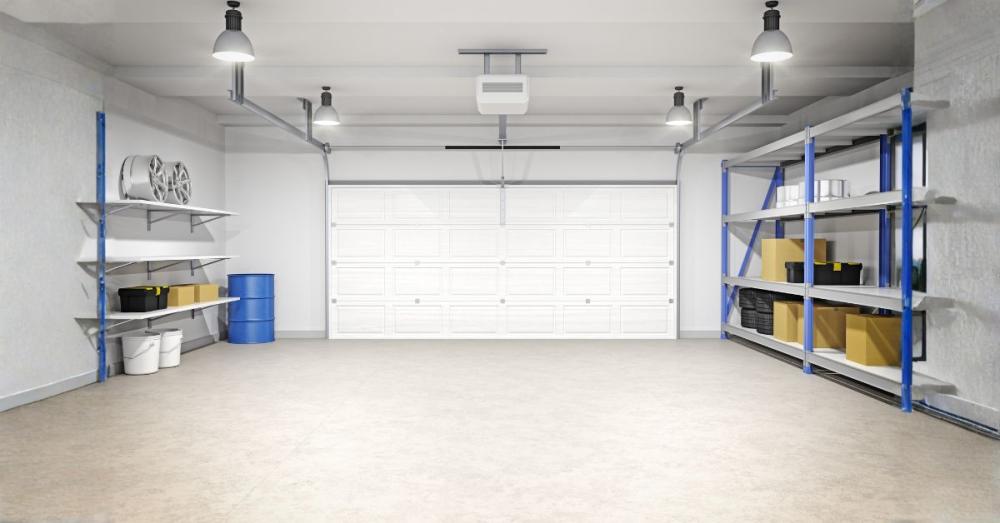
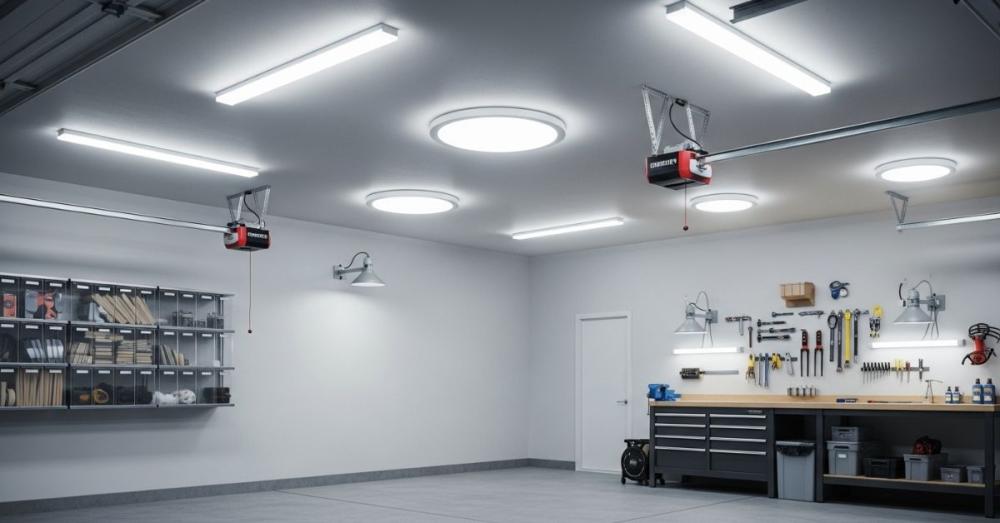
The best garage workshop lighting has two layers. General lighting lights the whole room evenly so you can move around safely, find tools and see trip hazards. Task lighting adds extra light exactly where you work, such as over the bench, the vice or a car's engine bay.
A single bare lamp in the middle of the ceiling fails on both counts. It leaves dark corners and puts your own shadow straight across the work. Several linear LED fittings spread across the ceiling, plus a strip of light over the bench, work far better.
Why good workshop lighting matters
- Safety: you can see blades, cables, spills and tools on the floor, and judge distances properly around machinery.
- Accuracy: measuring, marking out, wiring and paint matching are all easier when the light is even and colours look true.
- Comfort: even, glare-free light reduces eye strain on long sessions, especially in winter when you work after dark.
If your workshop is in a garden building rather than an attached garage, see our guide to powering a shed or garden building first.
Are LED lights better than fluorescent tubes for a garage?

Yes. For almost every garage the answer is now LED. Fluorescent battens were the standard for decades, but LED fittings give more light per watt, start instantly in the cold and need far less maintenance. New T5 and T8 fluorescent tubes have also been phased out of sale in the UK and EU since 2023, so replacements are getting harder to find.
| LED batten | Fluorescent batten | |
|---|---|---|
| Start-up | Instant full brightness | Can flicker and be slow to reach full output in a cold garage |
| Efficiency | More light per watt | Lower efficiency, plus ballast losses |
| Maintenance | Integrated LEDs, long rated life, no tubes to replace | Tubes and starters need replacing |
| Durability | Polycarbonate diffusers, many IP65 and IK-rated | Glass tubes can break |
| Availability | Wide choice of lengths, wattages and colour temperatures | New T5 and T8 tubes phased out of sale since 2023 |
When an old fluorescent fitting fails, the simplest fix is usually to replace the whole fitting with an integrated LED batten rather than converting it to take LED tubes.
How many lumens do you need for a garage workshop?
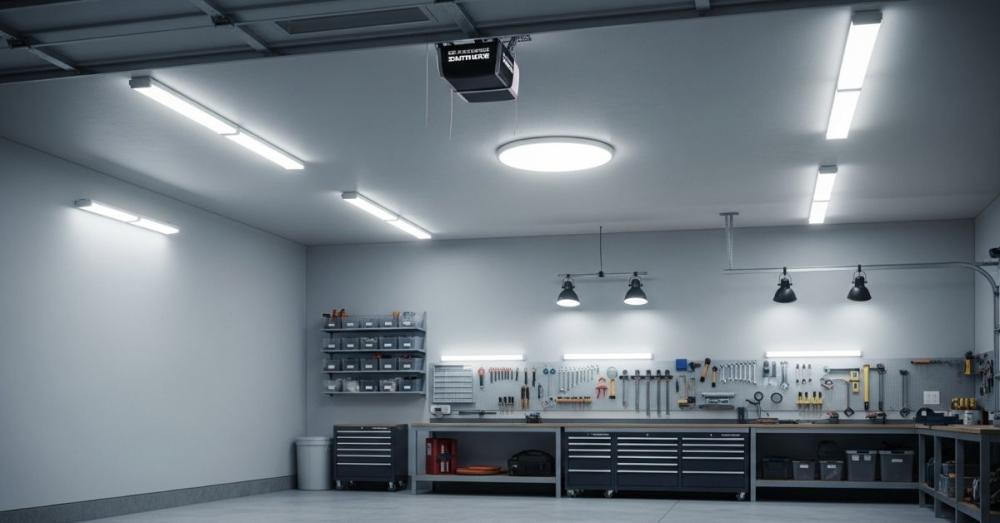
Lighting designers work in lux, which is the amount of light landing on a surface. One lux is one lumen spread over one square metre, so "lumens per m²" and "lux" are the same idea. These are typical targets for a garage or home workshop:
| Area or task | Typical target | Notes |
|---|---|---|
| Parking and storage only | 75–150 lux | Enough to move around safely |
| General garage and DIY use | 300 lux | Good baseline for most home workshops |
| Workbench, vehicle repair, machining | 500 lux | Add task lighting over the bench |
| Fine detail, inspection, paint matching | 750–1,000 lux | Use local task lights with high CRI |
How to work out the lumens for your garage
- Measure the floor area. Multiply length by width in metres. A typical single garage of 3 m × 6 m is 18 m².
- Pick a target lux. Use 300 lux for general workshop use, or 500 lux if you do detailed work across the whole room.
- Multiply area by lux. 18 m² × 300 lux = 5,400 lumens reaching the floor.
- Allow for losses. Not all the light lands where you want it, and dark walls absorb more. Add around 30% to 50%, which takes this example to roughly 7,000 to 8,000 lumens.
- Divide by the fitting output. Check the lumen figure on each fitting's datasheet, then spread the fittings evenly across the ceiling.
In practice that single garage would usually need two or three 5ft LED battens for general lighting, plus task lighting over the bench. A double garage or a workshop with dark walls needs proportionally more.
Pro tip: Compare lumens, not watts. Two LED battens with the same wattage can give quite different light output. Lumens per watt (efficacy) tells you how efficient a fitting is.
Which colour temperature is best for a workshop?
Most workshops use 4000K (neutral white) or 5000K to 6500K (daylight). Cooler light looks crisp and suits detailed work. Warmer 3000K light is better kept for living spaces. Many modern battens are CCT switchable, so you can choose the colour temperature on the fitting during installation.
Does CRI matter in a garage?
CRI (colour rendering index) shows how accurately colours appear compared with daylight. CRI 80 is fine for general work. Choose CRI 90 or above if you do paint matching, bodywork, woodworking finishes or anything where judging colour matters.
Which LED light fittings are best for a garage or workshop?
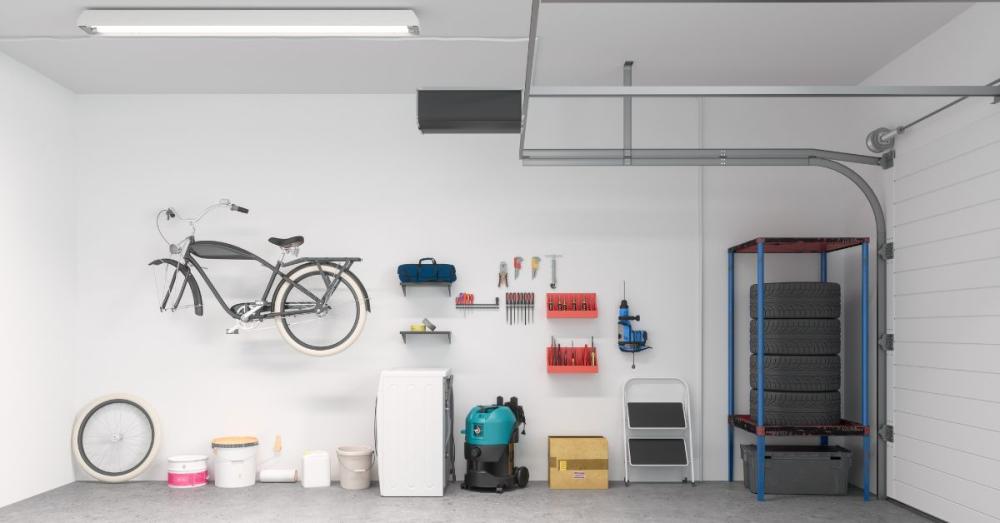
The right fitting depends mainly on ceiling height and how harsh the environment is.
| Fitting | Best for | Ceiling height | Typical IP |
|---|---|---|---|
| LED batten | Most domestic garages and home workshops | Up to about 4 m | IP20 to IP65 |
| Non-corrosive (vapour-proof) fitting | Damp, dusty or unheated garages, wash bays | Up to about 4 m | IP65 or higher |
| LED low bay | Commercial garages, larger workshops | About 4 m to 6 m | Often IP65 |
| LED high bay | Warehouses, barns, tall industrial units | About 6 m and above | Often IP65 |
| Under-shelf or LED strip | Task lighting over benches | Fixed at bench level | IP20 to IP65 |
LED battens: the best all-rounder
An integrated LED batten is the direct replacement for the old fluorescent tube fitting. It gives a long, even line of light, mounts straight to the ceiling and suits the 2.4 m to 3 m ceilings found in most garages. Ranges such as the Kosnic Niva let you switch both the wattage and the colour temperature on the fitting, which makes it easier to get the light level right.
IP65 non-corrosive battens for dusty or damp garages
Unheated garages get condensation, and workshops get dust. A sealed non-corrosive (vapour-proof) fitting is dust-tight and protected against water jets. The Kosnic Trent III 5ft non-corrosive batten, for example, is rated IP65 and IK10, with switchable wattage and colour temperature. It is a good choice for garages where you wash cars, use a pressure washer or do dusty work.
LED low bays and high bays for tall workshops
Battens lose their effectiveness on high ceilings, because the light spreads out before it reaches the floor. For ceilings above about 4 m, industrial LED lighting such as low bays (roughly 4 m to 6 m) and high bays (roughly 6 m and above) concentrates the light downwards. The Kosnic Cirrus III high bay is an IP65, IK10 option with switchable wattage, suited to commercial garages, barns and warehouse-style units.
Task lighting over the workbench
Ceiling lights are behind you when you stand at a wall bench, so you work in your own shadow. Fix a linear light under the shelf or wall cabinet above the bench. Under-cabinet and shelf lighting or LED strip in an aluminium profile with a diffuser gives a clean, glare-free line of light right where you need it.
LED lamps and tubes, and outdoor lights
If you simply want to upgrade an existing pendant or bulkhead, an LED lamp is the quickest fix, although it will not light a workshop on its own. Outside the garage, an IP-rated floodlight or bulkhead from our outdoor lighting range, ideally with a PIR sensor, lights the drive and door when you arrive after dark.
Video credit: original creator on YouTube. This video is US-made and uses some US terms and products.
What IP rating do garage lights need?
The IP (ingress protection) rating shows how well a fitting keeps out dust and water. The first digit covers solids and the second covers liquids. The IK rating shows how well it resists knocks, which matters in a workshop where ladders, timber and footballs can hit the ceiling.
| Rating | What it means | Where it suits |
|---|---|---|
| IP20 | Protected from fingers, no water protection | Dry, clean, heated garages only |
| IP44 | Protected from small objects and splashing water | Sheltered areas with occasional moisture |
| IP65 | Dust-tight and protected against water jets | Most garages and workshops, wash areas, unheated spaces |
| IP66 / IP67 | Powerful jets / temporary immersion | Harsh outdoor or wash-down areas |
| IK08 to IK10 | Impact resistance (IK10 is the highest) | Low ceilings or anywhere fittings can be knocked |
For most garages, IP65 is the safe choice. It is dust-tight, copes with condensation and washing down, and costs little more than an IP20 fitting.
How should you lay out garage workshop lighting?
- Run fittings parallel to the long walls and space them evenly, so the light overlaps and there are no dark bands.
- Keep fittings slightly in front of the bench rather than directly above your head, so your body does not cast a shadow on the work.
- Add task lighting over benches, machines and the vehicle bay.
- Use one colour temperature throughout so the space looks even.
- Consider controls. A PIR or microwave sensor is handy in a garage you walk through with full hands. Emergency versions of many battens keep some light on if the power fails.
Safety: Flickering light can make rotating machinery, such as a lathe chuck or saw blade, look slower or even stationary (the stroboscopic effect). Choose good quality, low-flicker LED fittings over machines and add local task lighting. The HSE guide Lighting at work (HSG38) covers this in more detail.
How do you compare LED garage lights when buying?
Check these points on the product page or datasheet before you buy:
- Lumen output and efficacy (lm/W): the real measure of brightness and efficiency.
- Length: 4ft, 5ft and 6ft battens suit different room sizes and ceiling layouts.
- Colour temperature and CRI: 4000K to 6500K for workshops, CRI 80+ or 90+ for colour-critical work.
- IP and IK rating: IP65 and IK08 or better for most garages.
- Ambient temperature range: important in unheated garages that drop below freezing.
- Options: switchable wattage or CCT, emergency versions, sensors and dimming.
- Brand and support: established manufacturers such as Kosnic publish full datasheets and back their products with a manufacturer warranty.
Can you install garage lights yourself?
Swapping like for like on an existing lighting point is a job many competent DIYers do, but new circuits, a supply to a detached garage or work in a special location are best left to a qualified electrician. In homes, BS 7671 requires 30 mA RCD protection for lighting circuits, and some work is notifiable under Building Regulations.
Safety: Always isolate the circuit and prove it dead before touching any wiring. Installations must meet BS 7671 in the UK (I.S. 10101 in the Republic of Ireland). If in doubt, use a registered electrician and check current regulations.
Key takeaways
- LED battens are the best all-round garage and workshop light for ceilings up to about 4 m.
- Aim for around 300 lux (lumens per m²) for general lighting and 500 lux or more over the bench, plus 30% to 50% for losses.
- Choose IP65 for dusty, damp or unheated garages, and IK08 or higher where fittings could be knocked.
- Use 4000K to 6500K colour temperature, and CRI 90+ if you judge colours.
- Use low bays or high bays only on taller ceilings, and add task lighting where you work.
Choosing the best LED lights for your garage workshop
The best LED lights for a garage workshop in the UK are usually simple: two or more evenly spaced LED battens, IP65 if conditions are harsh, with dedicated light over the bench. Work out your lumens from the floor area, pick a cool white colour temperature and check the IP and IK ratings, and you will have a brighter, safer space that costs less to run than old fluorescent tubes.
Shop LED garage and workshop lighting
LED battens, high bays and IP65 fittings from Kosnic and other leading brands. Trade prices, next working day delivery across NI & ROI on in-stock orders before 5pm.
Shop LED battens Shop high baysNeed help choosing? Call our team on 028 8675 1515 (048 from ROI), Monday to Friday, 8am–5pm.
FAQs
What is the best lighting for a garage workshop in the UK?
For most UK garage workshops, LED battens are the best choice. They give even, bright light, start instantly in the cold and are cheap to run. Choose IP65 non-corrosive battens for damp or dusty garages, add task lighting over the bench, and use low bays or high bays only on ceilings above about 4 m.
How many lumens do I need for a garage workshop?
Multiply the floor area in square metres by the light level you want. Around 300 lux suits general use and 500 lux suits detailed work. A 3 m by 6 m garage at 300 lux needs about 5,400 lumens at the floor, so plan for roughly 7,000 to 8,000 lumens from the fittings to allow for losses.
How many LED battens do I need for a single garage?
A typical single garage of about 18 m² usually needs two or three 5ft LED battens for general lighting, depending on their lumen output and the colour of the walls. Space them evenly along the length of the garage and add a separate task light over the workbench for detailed jobs.
What IP rating should garage lights be?
IP65 is the best all-round choice for a garage. It means the fitting is dust-tight and protected against water jets, so it copes with condensation, dust and washing down. IP20 fittings are only suitable for dry, clean and heated garages. Where fittings could be knocked, also look for an IK08 to IK10 impact rating.
What colour temperature is best for a workshop?
Most workshops use 4000K neutral white or 5000K to 6500K daylight white. Cooler light looks crisp and helps with detailed work. Keep the same colour temperature throughout the space for an even look, and choose CRI 90 or higher if you need to judge colours accurately, for example when paint matching.
When should I use high bay lights instead of battens?
Use LED high bays or low bays when the ceiling is too high for battens to light the floor well. As a rough guide, battens suit ceilings up to about 4 m, low bays suit about 4 m to 6 m, and high bays suit about 6 m and above, such as commercial units, barns and warehouses.